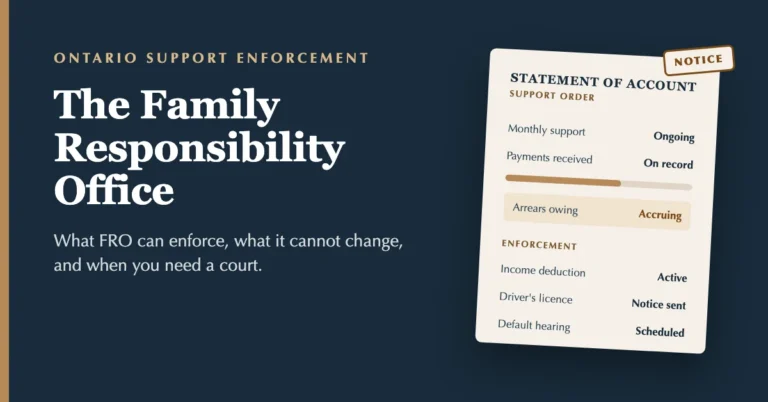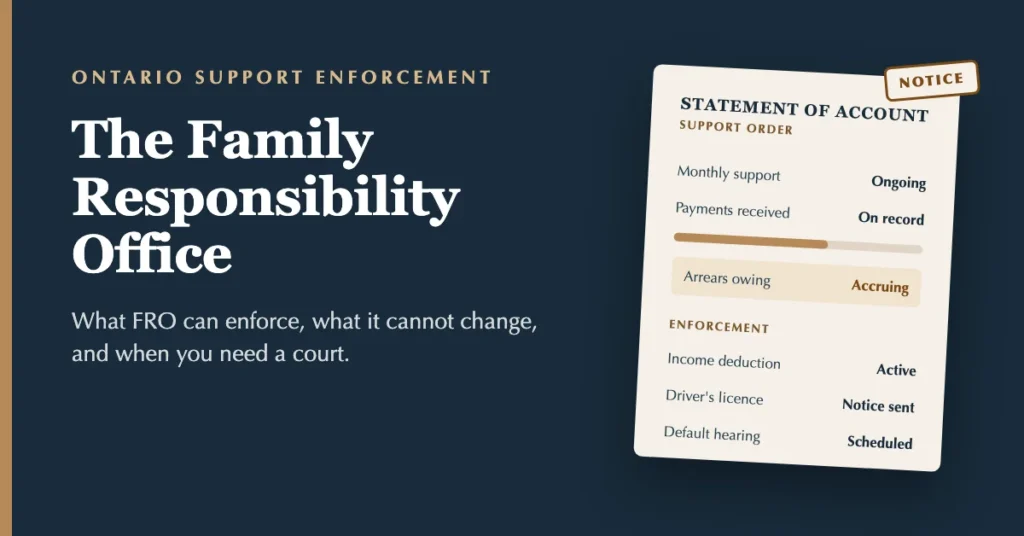

The Family Responsibility Office (FRO) is the Ontario government office that collects child support and spousal support. When the person who owes support stops paying, FRO can take steps to make them pay.
Every support order from an Ontario court goes to FRO automatically. A separation agreement must first be filed with the court and then registered with FRO.
FRO can take money from a paycheque or bank account. It can also suspend a driver’s licence or passport. But FRO cannot change how much support is owed, because only a judge can do that.
What the Family Responsibility Office can and cannot do
FRO is the middle person. The person who pays support, called the payor, pays FRO. FRO then sends the money to the person who receives it, called the recipient, usually within one or two business days.
If the payor has a job or a pension, FRO tells the employer or pension plan to take support off each payment. Once FRO has the case, all payments must go through FRO. If the payor pays the recipient directly, FRO’s records will be wrong, and FRO charges the payor a fee to fix them.
FRO does not pay support out of its own money when a payment is missed. It also does not deal with parenting time or custody. Those problems go through a different court process.
- Collect support and send it to the recipient
- Take support from wages, pensions and other income
- Take action when payments are missed
- Keep a record of what has been paid and what is owed
- Change how much support is owed
- Pay the recipient when the payor misses a payment
- Enforce something the order does not clearly say
- Settle disputes about parenting time or who makes decisions for the children
How a support order or agreement gets registered with FRO
If a court orders support, the court sends the order to FRO for you. FRO then contacts both people and mails out a welcome package with a seven-digit case number. Until FRO confirms the case is open, the payor must keep paying as the order says and keep proof of every payment.
A separation agreement, cohabitation agreement or marriage contract takes two extra steps.
- File the agreement with the court using a form called Form 26B
- Send FRO the agreement, the Form 26B the court signed and FRO’s registration forms
If there are no complications, Ontario says the first payment should arrive 30 to 60 days after FRO registers the case. It can take longer if the payor is not paying or FRO does not know where they work.
FRO can only enforce what the order clearly says
FRO can only collect what the order spells out. The order should state a dollar amount, how often it is paid and the date it starts. FRO cannot work out a new amount each year using the Child Support Guidelines.
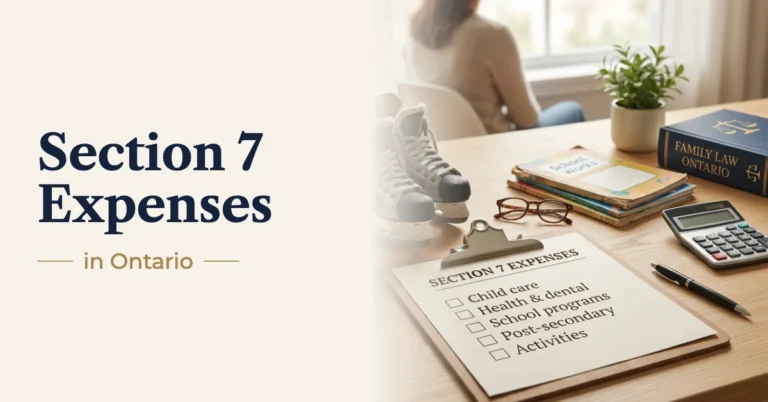
Section 7 expenses often cause problems. These are extra costs on top of regular support, such as child care or medical bills. FRO can only collect them if the order sets a fixed amount, or says the recipient can claim them on a sworn form called a Statement of Arrears.
Wording matters too. An order that says a parent must “pay” a set share is easier to enforce than one that says the parents will “share” costs.
What FRO can do when support payments stop
FRO usually tries a payment plan first. If the payor will not agree to one, or stops following it, FRO can use the tools below. Ontario also lists them on its support enforcement page, and FRO does not have to use them in a set order.
FRO can have support taken from wages, pensions and other regular income. It can take up to 50% of net pay, which is pay after income tax, Canada Pension Plan, Employment Insurance and union dues.
Up to 50% of net payFRO can take money from the payor’s own bank account to cover everything owed. From a joint account it can take no more than half the money in it, and the other account holder has 30 days to dispute this in court.
Joint accounts 50% maxFRO can ask the federal government to send it money that is owed to the payor. This includes all of a tax refund and up to half of Employment Insurance or Canada Pension Plan payments.
Up to 100% of a tax refundIf no payment has been made for more than 60 days, FRO can warn the payor that it will report them to the credit bureau. The payor has 15 days to respond, and the report stays on their credit history for six years.
15 days to respondFRO sends a warning before it suspends a licence. The payor then has 30 days to pay what is owed, agree to a payment plan or get a court order that stops the suspension.
30 days to respondFRO can ask the federal government to suspend or refuse a passport, pilot licence or marine licence. This can happen after three missed payments or once $3,000 is owed.
3 missed or $3,000FRO can put a claim, called a lien, on a home, car or boat. It can also file a court order called a writ with the sheriff, so the debt must be paid before the property is sold or refinanced.
Paid before a saleAfter three months without payment, FRO can report the payor to their professional or trade organization. It can also take any single lottery prize over $1,000.
30 days to respondFRO can take the payor to court to explain why they have not paid. The judge can set a payment schedule, order them to ask the court to change support, or send them to jail for up to 180 days.
10 days to actA payor who gets a notice of a default hearing has 10 days to act. The payor fills out the forms that come with the notice and sends them to FRO’s Legal Services Branch before the deadline it gives.
Missing the hearing can lead to an arrest warrant, and going to jail does not erase the debt. A judge can also make someone else pay if the payor moved money or property to them to avoid support. Our guides to what happens when child support is not paid and hiding income from child support explain more.
If you are owed support and the payments have stopped
First, check that your FRO case is open. If no payment has arrived in more than 30 days, contact FRO online or call 416-326-1817 or 1-800-267-4330. Ontario asks recipients not to contact the payor’s employer themselves.
FRO cannot promise when the money will arrive. It also cannot collect on an agreement that was never filed, or on terms the order leaves unclear. In those cases our child support lawyers can file the agreement, ask the court to make the order clearer or ask for other help.
Claiming money that is missing from FRO’s records
Some money you are owed is not in FRO’s records until you claim it. This includes support missed before FRO had your case, unpaid extra expenses and interest.
You claim it on a form called a Statement of Arrears. You must swear or affirm it in front of a commissioner for taking oaths, such as a lawyer. FRO says it updates the account in about 30 days.
Interest on unpaid support
You can claim interest if your order sets an interest rate. If it does not, you may still be able to claim interest under Ontario’s Courts of Justice Act.
It depends on which court made the order and when, with start dates in 1999 or 2004. You claim interest on the same Statement of Arrears.
When the payor lives outside Ontario
FRO can still collect if the payor lives in another province or territory, a U.S. state, or a country that has an agreement with Ontario. The steps depend on where the payor lives. If they live in a country with no agreement, Ontario suggests getting legal advice.
If FRO is enforcing support against you
Contact FRO as soon as you fall behind. FRO may agree to a payment plan for what you owe, as long as you also keep up with your regular support. To ask for one, you send FRO a proposal form and a financial statement.
Always pay through FRO, not to your former partner. Every FRO notice has a deadline, and that deadline is the most important part of it. Some options are lost once it passes.
Being unable to pay is different from refusing to pay
At a default hearing, the judge assumes you are able to pay. The judge also assumes FRO’s record of what you owe is correct. It is up to you to prove otherwise with financial records.
A judge will not send you to jail or order full payment if you show a valid reason you cannot pay. Losing your job, getting sick or earning less from your business can count, if you have proof. Stopping payments in protest, or because of a parenting time dispute, does not count.
A driver’s licence notice gives you 30 days
You can ask the court to stop a licence suspension. This is called a refraining order. To get one, you must also ask the court to change your support order, which is called a motion to change.
You can ask for the refraining order first if you promise to get a court date for the motion within 20 days. But the court cannot make the order once the 30 days in FRO’s first notice have passed.
Why arrears keep growing until a court changes the order
Arrears are support that is owed but has not been paid. FRO collects what the order says, even if your income goes down. Every missed payment adds to the arrears until a judge changes the order.
A payment plan does not stop this. Under Ontario’s Family Responsibility and Support Arrears Enforcement Act, arrears keep adding up even while you follow a payment schedule set by the court. You owe the full amount until the order itself is changed.
What changing the order involves
To change support, you usually file a motion to change. You must show a material change in circumstances, and not every drop in income counts. You also have to share full financial records.
Courts rarely cancel child support arrears. Under Colucci, you must prove that even with a flexible payment plan, you cannot pay and never will be able to.
The person receiving support can also ask for an increase covering past years, as our guide to retroactive child support explains.
Support does not stop on its own
Child support in Ontario does not end on its own when a child turns 18. Keep paying until FRO tells you in writing that you can stop. If you think support has ended, you can ask FRO to stop enforcing it, and FRO will check with the recipient.
How long spousal support lasts depends on the order or agreement. Our guide to how long spousal support lasts explains what decides it.
Opting out of FRO and when it makes sense
You can take your case out of FRO and handle support between yourselves. If the payor is up to date, you both sign a notice of withdrawal. If the payor is behind, the recipient can withdraw alone.
Some cases cannot leave FRO. An order may say it must stay with FRO. If the support has been signed over to a social assistance office, that office must agree first.
Opting out can work for two people who have paid on time for years and keep good records. It is riskier if payments have been late before, because FRO stops all enforcement once the case is withdrawn. Either person can register with FRO again later, and the recipient can then claim missed payments on a Statement of Arrears.
When FRO is not enough and you need the court
FRO collects support. It cannot rewrite an order, settle a disagreement about an expense or decide what someone really earns. Those questions go to a judge.
You will likely need the court in these situations.
- Your income has changed and the support amount no longer fits
- The order is too unclear for FRO to enforce
- You have an agreement that was never filed, or you disagree about what it says
- You think FRO’s record of what is owed is wrong
- You need to stop a driver’s licence suspension
- You have received a notice of a default hearing
- The payor seems to be hiding income or passing it through someone else
A Toronto family lawyer can ask the court to change an order, defend you at a default hearing or enforce terms FRO cannot. FRO collects spousal support the same way as child support, and our spousal support lawyers can help with those cases too.
Get advice on a Family Responsibility Office problem
If support you are owed is not arriving, or FRO is taking action against you, talk to a lawyer before the deadline in any notice.
Barry Nussbaum is certified by the Law Society of Ontario as a Specialist in Family Law. Start with a free case review.
- Your support order or filed agreement
- Your FRO case number and statement of account
- Every notice FRO has sent you, with its date
- Proof of your income for the past three years
Family Responsibility Office questions
How long does it take the Family Responsibility Office to start paying support?
If there are no complications, Ontario says the first payment should arrive 30 to 60 days after FRO registers the case. It can take longer if the payor is not paying or FRO does not know where they work. After that, FRO usually sends each payment on within two business days.
Can FRO lower my support if I lose my job?
No. FRO cannot change the amount of support, and only a court can, usually through a motion to change. Contact FRO about a payment plan and get legal advice soon, because arrears keep growing until the order is changed.
Does FRO enforce separation agreements?
Yes, once you file the agreement with the Ontario Court of Justice or the Superior Court of Justice using Form 26B and register it with FRO. FRO cannot enforce an agreement that was never filed.
Can I stop using the Family Responsibility Office?
Usually, yes. Both people sign a notice of withdrawal if the payor is up to date, or the recipient can withdraw alone if the payor is behind. Some orders must stay with FRO, such as orders that say so and support signed over to a social assistance office.
How much can FRO take from my wages?
Your employer cannot take more than 50% of your net pay for support. Net pay means your pay after income tax, Canada Pension Plan, Employment Insurance and union dues. Tax refunds are different, and FRO can take all of a refund.
Can child support arrears be forgiven in Ontario?
FRO cannot forgive arrears. Only a court can lower or cancel unpaid support, and courts rarely cancel it. Under the Supreme Court of Canada’s decision in Colucci, you must prove that even with a flexible payment plan, you cannot pay and never will be able to.