



Most people think getting a court order changed is simple. It’s not.
I hear it all the time. “My ex got a raise.” “I lost my job.” “The kids are older now.” And look, those things might matter. But “might” and “will” are very different words in a courtroom.
In Ontario family law, you can’t just walk into court and say things have changed. You need to prove a MATERIAL change in circumstances. That’s a specific legal test with specific requirements, and courts reject MOST applications that try to meet it. Not because the situations aren’t real, but because the applications are weak, poorly timed, or based on changes that don’t actually qualify.
I’ve spent years helping clients figure out whether their situation has legs before they spend money filing. Because the worst thing you can do is file a motion to change when you don’t have the evidence to back it up. You burn credibility with the court and you burn cash you can’t get back.
If this is your situation right now, call us. We’ll help you figure out what comes next. First though, let me break down what the court actually cares about.
The Three-Part Test Ontario Courts Apply to Material Change
Ontario courts don’t just eyeball your situation and decide if things feel different. There’s a specific legal test from the Supreme Court of Canada’s decision in Willick v Willick. Every single motion to change runs through it, whether you’re trying to adjust spousal support in Ontario or modify a custody arrangement.
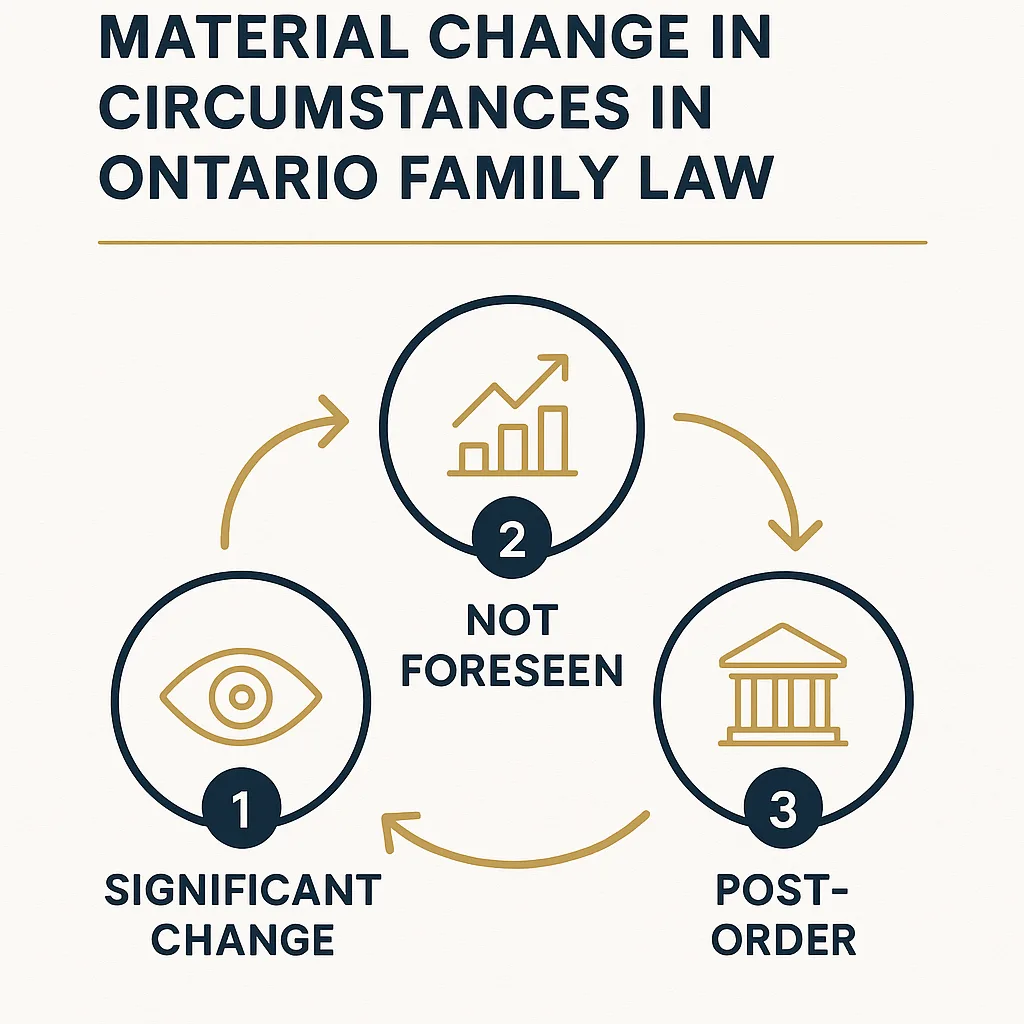
Three things you have to prove. Miss one and you’re done.
1. The Change Must Be Significant
Small shifts don’t count. A $200 per month pay cut? Probably won’t move the needle. Basically, if the judge had known about this change back when the original order was made, would the order have come out differently? If the answer is no, you don’t have a case.
Put it another way. Would the original judge have shrugged and made the exact same order? Then your change isn’t material. It has to actually move the math on support or meaningfully alter the parenting arrangement. Otherwise you’re wasting everyone’s time.
2. The Change Must Not Have Been Foreseen
Here’s where a lot of people get tripped up. If the change was something the court already considered (or could’ve considered) when the original order was made, it doesn’t count. Done. The court already factored it in.
I had a client a couple years back who told me his income dropped after he retired. Sounds reasonable, right? But the original order was made when he was 62 and everyone in the room knew retirement was coming at 65. The court isn’t going to treat that as a surprise. The judge already accounted for it, whether explicitly or by assumption.
The change has to be something NEW. Something nobody saw coming. Or at the very least, something that wasn’t part of the picture when the original order was set.
3. The Change Must Have Occurred Since the Original Order
You can’t go back and re-litigate facts that existed before the order was made. Knew about a financial issue and didn’t raise it during the original proceeding? Too late. That ship sailed.
The court draws a hard line here. Everything before the order is settled. Only things that happened AFTER matter for a variation application.
Timing Matters: When to Bring a Material Change Application
Getting the timing right is almost as important as having the change itself. I’ve watched strong cases fall apart because someone jumped the gun or sat on their hands too long.
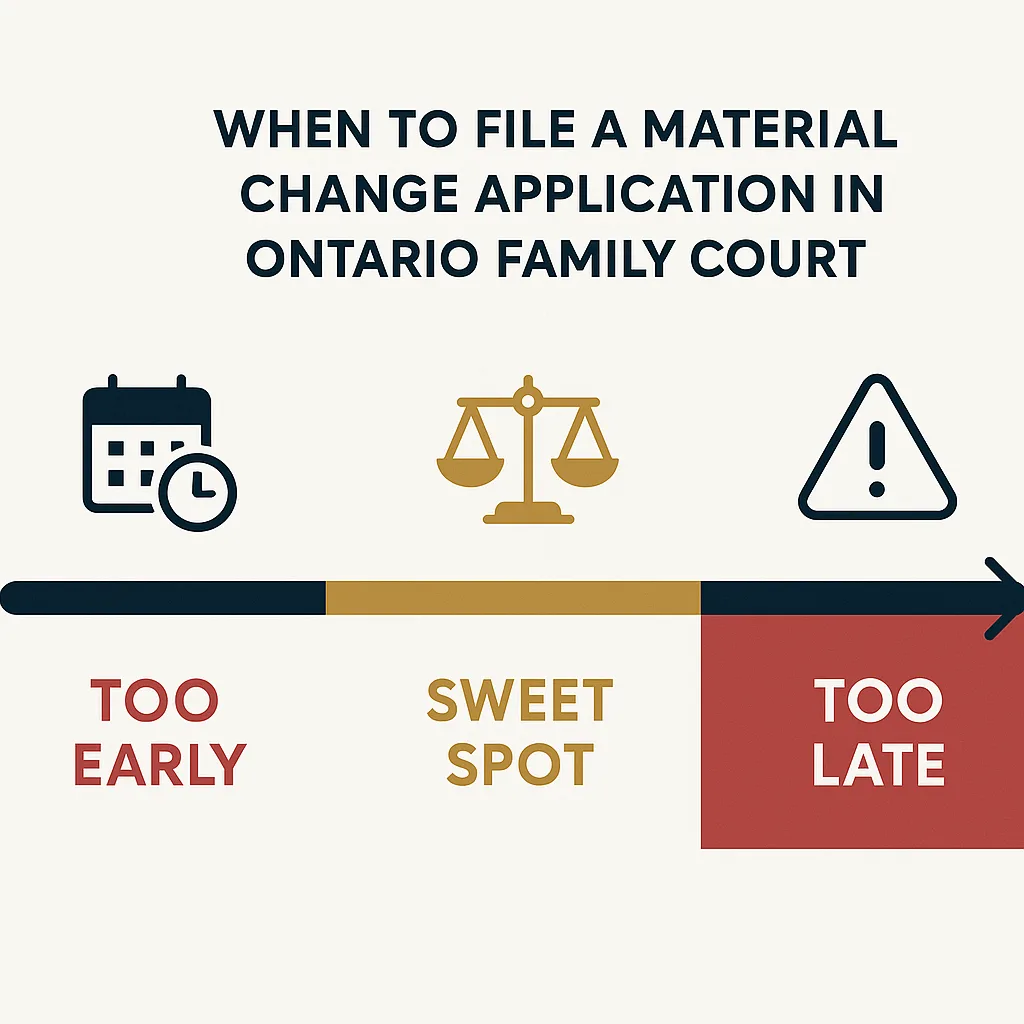
File too soon after the original order and the court gets suspicious. Judges really don’t like seeing motions to change filed three months after a final order. Judges see right through that. Unless something truly dramatic dropped on you (sudden disability, surprise layoff), let the original order breathe for a while.
Wait too long, though? Different problem. If you lost your job a year ago and you’ve been drowning in support payments ever since, the court’s going to want to know why you didn’t bring this forward sooner. Delay kills your argument. Plus you’re racking up arrears the whole time, and the court may or may not forgive those.
The sweet spot is filing once the change is clearly established and you’ve got the paperwork to prove it. Don’t file on day one of a job loss. Wait until you’ve been actively searching, you’ve got records showing reduced income, and you can show this isn’t just a rough couple of weeks. But don’t sit on it for six months either.
I tell clients the same thing every time. The moment you realize the change is real and lasting, come talk to a lawyer. We’ll figure out the right time to file together.
What Qualifies as a Material Change in Ontario
So what actually counts? There’s no definitive list carved in stone, but courts have recognized certain situations over and over again.
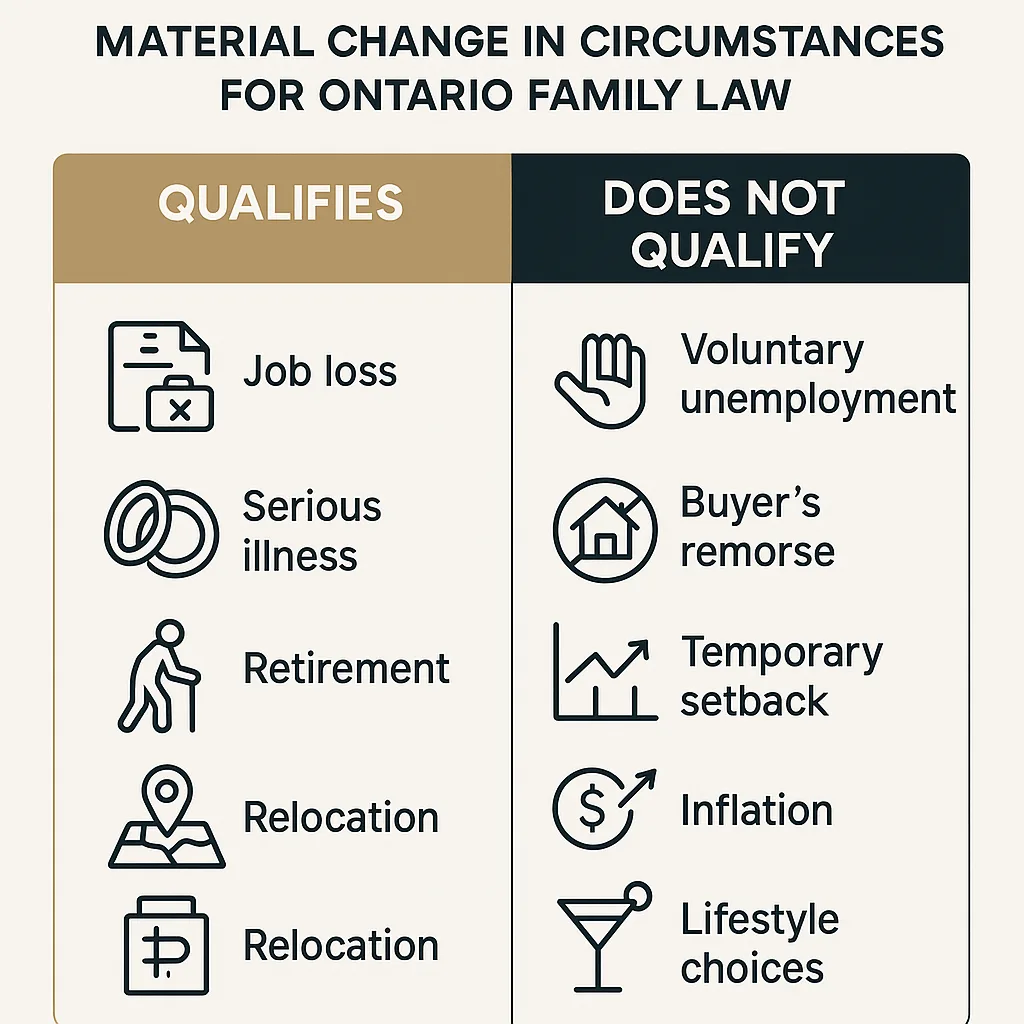
Income changes are the most common. Got laid off, became disabled, or your ex landed a massive raise? That can qualify. But the change has to be real and lasting. A two-week break between jobs doesn’t cut it.
Health issues carry real weight when they affect someone’s ability to earn or care for kids. A serious diagnosis. A mental health crisis. A physical injury that changes your capacity to work. All potentially material.
Then there’s changes in what the kids need. A child developing special needs, hitting an age where expenses jump, or starting university can all trigger a review of child support obligations. Same goes for a teenager who decides they want to live with the other parent full-time. That happens more than people expect.
Remarriage or new common-law relationships can shake things up too, especially on the spousal support side. If the recipient moves in with a new partner who’s splitting the bills, that’s relevant. But it’s way more nuanced than most people think. I’ll get into that in the FAQ section.
Retirement catches people off guard. If a payor retires at a reasonable age and their income drops substantially, that can qualify. But “reasonable” is doing a LOT of heavy lifting in that sentence. Retiring at 55 because you feel like it when the order assumed you’d work until 65? Not going to fly.
Relocation matters too. One parent moves far enough away that the existing child custody arrangements stop working? The court needs to revisit things. Same deal for domestic violence situations that surface after the original order.
And sometimes changes to the division of property intersect with support obligations, particularly when one spouse receives a big asset or inheritance that wasn’t part of the original calculation.
What Does Not Qualify as a Material Change
Real talk. This section matters more than the last one. Knowing what DOESN’T qualify saves you from filing a motion that goes absolutely nowhere.
Buyer’s remorse? Not a material change. You agreed to a settlement and now you think you got a raw deal. Tough. The court expects you to live with what you signed, especially if you had a lawyer sitting next to you when you signed it.
Voluntary underemployment is a big one. If you quit your job or deliberately took a lower-paying gig to shrink your support payments, the court will impute income to you. That means they’ll calculate support based on what you COULD be earning, not what you chose to earn. I’ve seen this blow up spectacularly on payors who thought they’d found a clever loophole. They hadn’t.
Temporary changes won’t get you there either. A bad quarter at work. A short illness. A brief stretch of unemployment. Not enough. The court wants to see something LASTING, not a rough patch you’ll bounce back from.
General inflation? Nope. Yes, everything costs more. The court knows that. But rising grocery prices aren’t the same as a material change in YOUR specific circumstances. Big difference.
And your ex’s lifestyle choices? Irrelevant. Your ex bought a new car or took a vacation. So what. The court looks at financial circumstances, not how someone chooses to spend their money.
Common Mistakes That Kill a Material Change Application
I’ve reviewed hundreds of these over the years. The mistakes repeat like clockwork.
Number one killer: filing without proper financial disclosure. Financial statements, tax returns, pay stubs, proof of whatever changed. You need ALL of it. Show up to court with a great story and an empty folder? Guaranteed loss. Judges decide based on evidence. Period.
Confusing a temporary setback with a permanent change is another one I see constantly. You got laid off last month and you’re panicking about support payments. I get it. But if you’re in a field where comparable work is probably a few months away, the court won’t treat your job loss as material. Wait until the picture is clearer before you file.
Not showing you’ve tried to help yourself? That hurts. Lost your job? The court expects to see proof you’ve been pounding the pavement. Health changed? They want medical records and evidence you’re following treatment. Sitting back and doing nothing doesn’t play well with judges.
Self-representing on complex financial matters is risky. Look, I’m not saying everyone needs a lawyer for every family court issue. But material change applications involve technical legal tests, specific evidentiary requirements, and strategic calls about timing and framing. Get any of those wrong and you lose. Worse, you might have trouble bringing the same application again later.
Here’s one that surprises me every time. People write detailed affidavits about their situation but never actually connect it to the three-part test. They describe everything that happened but don’t explain how the change is significant, unforeseen, and post-order. If you don’t spell it out for the judge, the judge isn’t going to do your homework for you.
Don’t file until you’ve talked to someone who does this every day. Trust me on this one. The consultation pays for itself.
Who Bears the Burden of Proof
The person asking for the change carries the burden. Full stop.
If you’re the one filing, you need to prove all three parts of that test I described above. Your ex doesn’t have to prove a thing. They just sit there and poke holes in your case. That’s a real advantage for the other side, and it’s a big reason why so many of these applications fail.
The standard is balance of probabilities. “More likely than not.” This isn’t criminal court. You don’t need proof beyond a reasonable doubt. But you DO need actual evidence showing the change is real, significant, nobody saw it coming, and it happened after the order was made.
Where most people fall short? The evidence. They’ve got a genuine change but they don’t have the documents to back it up. Medical records, employment records, financial statements, school records for the kids. You need all of it. Organized. Clearly presented. No excuses.
Before you file, it’s worth considering whether mediation or arbitration might be a smarter route. If both sides agree the circumstances have changed, you can formalize the new arrangement through divorce mediation without the cost and uncertainty of going before a judge. I always explore that option with clients first.
How to File a Motion to Change a Spousal Support Order in Ontario
Alright, so you’ve decided to move forward. You start by filing a Motion to Change, which is Form 15 in Ontario’s family court system. That’s the document you file to ask the court to vary an existing order.
You’ll complete the motion form along with a sworn affidavit laying out the facts. This is where you lay it all out for the judge. What changed. When it changed. Why it meets the legal test. Be clear, be factual, and for the love of everything, be concise. Judges read hundreds of these. They don’t want your autobiography. They want evidence connected to law.
You also need an updated Financial Statement (Form 13 or Form 13.1 depending on your situation). This shows the court your current income, expenses, assets, and debts. If the whole point of your application is that your finances changed, this document better be accurate and thorough.
Once your materials are filed, you serve them on the other party. They get a chance to respond with their own affidavit and financial statement. Then there’s usually a case conference before anything gets to a hearing.
The Ontario government has a step-by-step guide to filing a motion to change that covers the procedural stuff. But procedure is only half the battle. How you frame the change and what evidence you attach is what actually determines whether you win or lose.
If you’re going through the divorce process in Ontario or you’ve already got a final order in place, getting the motion right the first time saves you real money.
Can You Modify Child Support for a Material Change in Circumstances?
Yes. And honestly, the rules are a bit more straightforward here than with spousal support.
Child support obligations in Ontario run through the Federal Child Support Guidelines. The base amount comes down to the payor’s income and how many kids there are. So when income changes significantly, the support amount should change too. Pretty simple math.
A lot of separation agreements and court orders already include a clause requiring both parties to swap income information every year. If the payor’s income went up or down by a meaningful amount, either side can ask for an adjustment. Sometimes that happens by agreement. No court needed.
When agreement isn’t possible, you file a Motion to Change the same way you would for spousal support. Same three-part test applies. The good news? A significant, documented income change is usually easier to prove on the child support side because the Guidelines are so formula-driven. Income dropped by $30,000? The math does the talking.
Parenting time changes can trigger a variation too. If the kids start spending way more time with the payor, the support calculation may shift to a set-off arrangement. Changes in a child’s expenses (think special medical needs, expensive extracurriculars) can also matter under Section 7 of the Guidelines.
One thing worth knowing. Even if you’ve got a cohabitation agreement that addresses support, the court always keeps the power to vary child support in the best interests of the children. You can’t contract away a child’s right to appropriate support. Not negotiable.
When You Need a Lawyer for a Material Change Application
Not every family court matter requires a lawyer. I’ll be straight about that.
But material change applications? This is one where I strongly recommend getting legal advice, even if you handle parts of the process yourself after that. The legal test is specific. The evidence requirements are technical. And the consequences of getting it wrong are real. A failed application doesn’t just waste your time and money. And it makes it way harder to bring the same issue forward down the road.
I’ve seen people with genuinely strong cases lose because they didn’t frame things right. Wrong supporting documents. Didn’t address the three-part test in their affidavit. Those are mistakes a family lawyer catches before they happen.
Certain situations make legal representation especially important. The other side has a lawyer and you don’t? You’re behind from day one. Complicated financial picture with business income, stock options, or self-employment? You need someone who knows how to present that evidence properly. History of conflict or power imbalance? Having a lawyer protects you through the whole process.
At a bare minimum, get a consultation before you file anything. A good family lawyer will tell you straight whether your situation qualifies, what evidence you need, and whether it makes sense to go now or hold off. That single meeting can save you thousands of dollars.
Call Nussbaum Law or book a consultation. We’ll tell you straight whether your situation has legs.
Frequently Asked Questions
What is a material change in circumstances in Ontario family law?
It’s a significant shift in the facts that existed when a court order or agreement was made. To qualify, the change has to be big enough that it would’ve led to a different order. It can’t be something that was foreseen at the time. And it has to have happened after the order was made. The Supreme Court of Canada set that three-part test and Ontario courts apply it to both spousal and child support variations.
Can I change a spousal support order if I lose my job?
Maybe. It depends. Maybe. A job loss CAN qualify. But the court wants to know everything. Did you get fired or did you quit? Is this temporary or are you looking at a career change? And critically, have you actually been applying for comparable work? One of my clients got laid off after 14 years at the same company. He’d been applying to everything in sight, saved every rejection email. Strong case. But if you quit to lower your income on purpose? The court will impute what you could be earning and your application’s dead on arrival.
What are examples of a material change in circumstances?
The ones courts see most often: a significant and lasting income change for either party, a serious health issue affecting earning capacity, a child developing special needs, a major shift in parenting time, retirement at a reasonable age, one parent relocating, or a recipient spouse moving in with a new common-law partner. Every situation gets assessed on its own facts though. And the change still has to clear all three parts of the legal test. No shortcuts.
How long does it take to change a spousal support order in Ontario?
Honestly? It varies wildly based on where you are and how much the other side wants to fight. If both parties agree? You can wrap it up in a few months with a consent order. Contested? Now you’re looking at a case conference, maybe a settlement conference, possibly a hearing. In busy court centres like Toronto or Ottawa, that process can drag on six months to over a year. Having your documentation ready from day one helps. So does exploring divorce mediation as an alternative. Way faster when both sides are willing to talk.
Can my ex reduce spousal support because I started dating someone?
Dating someone? No. The court doesn’t care about your love life. But moving in with a new partner who’s contributing to the household bills? That’s different. Your ex could argue your financial needs went down. The analysis focuses on whether your actual financial circumstances changed as a result of the new living arrangement. Even then, it doesn’t automatically eliminate support. The court cares about whether your bills went down, not whether you’re in love.
What happens if I don’t report a change in my financial circumstances?
Nothing good. If you’re a payor whose income went up and you kept quiet about it, the other side can bring a retroactive motion to increase support going back to when the change actually happened. Recipient who started earning more and didn’t say anything? You could be facing a retroactive reduction. Courts take disclosure obligations seriously. Getting caught hiding information tanks your credibility for every future court appearance. And in some cases? It can be treated as contempt. Not worth the risk.
Do I need a lawyer to file a motion to change spousal support?
Legally required? No. You can file a Motion to Change yourself using Form 15 and the supporting documents. But I’d strongly recommend at least sitting down with a family lawyer before you file anything. The three-part test is specific and technical. If your application doesn’t properly address each element with real evidence, it’ll fail. A consultation at Nussbaum Law can help you figure out whether your case is strong enough and make sure your materials are put together right.