


In Ontario, a separation agreement is legally binding once it is in writing, signed by both of you and witnessed. It’s where separating couples, married or common-law, write down what they’ve worked out: who keeps the house, who has the kids on Fridays, and what support gets paid.
A judge can still change parenting terms that don’t serve your children, or cancel the agreement if one of you hid a bank account or signed without understanding it.
What is a separation agreement in Ontario?
It’s a contract you and your ex sign after you split up, whether you were married or lived common-law.
There’s no “legal separation” to file with the government. You’re separated from the day you live separate and apart, even under one roof if you sleep, eat and handle money separately.
If you’re married, signing it doesn’t end the marriage. Only a court divorce does that.
When is a separation agreement legally binding in Ontario?
Section 55(1) of the Family Law Act says your agreement is binding once it meets three signing rules. After that, a court can cancel it only for a few reasons, and can still change some terms.
The three signing rules
- It’s written down.
- You both sign it.
- You sign in front of a witness, who signs too. The witness can be any adult who isn’t one of you, and doesn’t need to be a lawyer or a notary.
Reasons a court can cancel it
- One of you hid a significant debt or asset.
- One of you didn’t understand the agreement.
- One of you signed under pressure, or by mistake.
Terms a court can still change
- Parenting terms that don’t serve your children.
- Child support far below the guidelines amount, because that money belongs to the child.
- Spousal support terms, if giving it up was shockingly unfair or left that spouse on social assistance, or if agreed payments stop.
What to include in a separation agreement in Ontario
Your agreement should settle every decision in the checklist below, with names, dollar amounts and dates. A line like “we’ll split things fairly” is hard to enforce.
Sample terms: vague versus clear
Examples only, not wording to sign: use them to see how specific your own terms need to be.
| Term | Vague | Clear |
|---|---|---|
| The home | We’ll sort out the house later. | Lena keeps the house at 12 Elm Street and refinances the mortgage into her own name by June 30, 2027. |
| The parenting schedule | The kids spend time with both parents. | The kids are with Rob every second weekend, Friday 5 p.m. to Sunday 5 p.m., and Rob and Lena alternate Christmas Eve and Christmas Day each year. |
| Child support | Rob will pay child support. | Rob pays Lena $1,200 a month, the federal child support table amount for his income and two children, on the 1st of each month starting July 1, 2026. |
| Updating support | Support will be adjusted when needed. | Each June 1, Rob and Lena share their tax returns, and child support is reset to the federal table amount for Rob’s new income. |
| Future disagreements | We’ll work it out. | If they disagree, Rob and Lena see a mediator before either of them goes to court. |
A few items need extra care:
- The home. If you’re married, you both have an equal right to live in the family home, and neither of you can sell it without the other’s consent or a court order.
- Parenting. Record who makes the big decisions, like school, and the days and nights the kids spend with each of you (once called custody and access). A parenting plan helps with the schedule, and you can read about shared parenting.
- Child support. Record the monthly amount. The federal child support look-up gives the basic amount, which can change if each of you has the kids at least 40% of the time, or each of you has a different child most of the time.
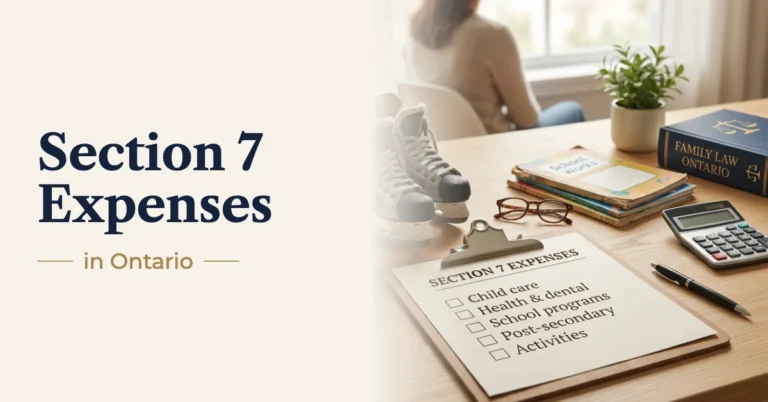
- Extra costs. Record how you’ll share extras like child care, called section 7 expenses.
- Spousal support. Record whether one of you pays, how much and for how long. It usually depends on whether caring for the kids or the home held back a career, or one of you needs support and the other can afford it.
If you’re afraid of your partner, or the two of you can’t talk even with help, an agreement may not be the right first step. Speak to a lawyer about other options.
Your separation agreement checklist
Your separation agreement checklist
Tick what you’ve done, print the list and bring it to your case review, even if half of it is still blank.
Gather these papers
Decide together
Before you sign
If you already agree on the terms, we draft your agreement for a flat fee of $3,100 + HST.
The case review is free, done by a member of our team, and gives no legal advice.
How to make a separation agreement in Ontario, step by step
Seven steps to a signed agreement
Work through them in order.
Step 1
Swap your financial papers
Each of you hands the other your financial disclosure: pay stubs, tax returns and a statement for every account and every debt. If one of you hides a significant debt, a court can cancel the agreement later.
Step 2
Work out what each of you owns
- If you’re married, each of you adds up what you own on the day you separate, minus your debts and what you owned on your wedding day. The spouse with the higher total pays the other half the difference. This equalization payment is money, not a split of every item.
- The family home counts in full, even if one of you owned it before the wedding.
- A gift or inheritance you got during the marriage usually stays out of that count, unless it went into the family home.
- Common-law partners usually keep what’s in their own name, but may still have a claim to common-law property.
Step 3
Agree on the rest
Note what you still disagree on, like who has the kids at Christmas. A mediator, a neutral person who helps you reach a deal, can help. If your spouse won’t sign at all, you still have other routes.
Step 4
Put it in writing
If you hire us, our lawyer writes the draft for one of you from the terms you’ve agreed.
Step 5
Get your own legal advice
Each of you takes the draft to your own lawyer before signing. We act for one of you only, because one lawyer can’t act for both.
Step 6
Sign in front of a witness
Date it and sign in front of your witness, who signs too.
Step 7
File it if you want support enforced
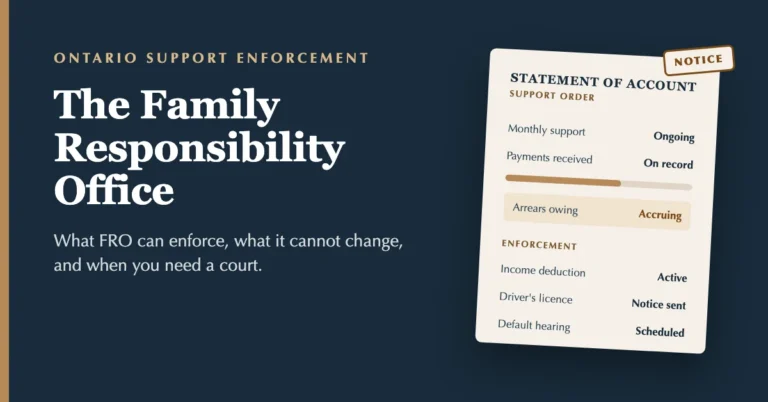
Your agreement is valid without filing. If it sets support, you can file it with the court so the Family Responsibility Office can enforce the payments. Here’s how to file it.
Married or common-law: how the rules differ
Your rules at a glance
Find the topic you need.
| Topic | Married | Common-law |
|---|---|---|
| Sharing property | The spouse with the higher total pays the other half the difference. | No equalization payment, but you may have a claim. |
| The family home | You can both stay, whoever owns it. | Only married spouses get these home rights. |
| Spousal support | You can ask once you show you’re entitled. | After three years living together continuously, or sooner if you have a child together and a lasting relationship. |
| Pensions | The part earned during the marriage counts. | You can agree to share one, or an arbitrator can decide. The plan’s rules still apply. |
Property deadline for married spouses
To ask a court for an equalization payment, apply within two years after the divorce or six years after you separate, whichever comes first. Separate in 2026 and divorce in 2028, and it falls in 2030. If a spouse dies first, it can be as short as six months after the death.
Get your separation agreement drafted for a flat fee
This is for spouses who already agree on the main terms. We act for one of you, and your spouse gets their own lawyer.
Flat fee for a separation agreement
$3,100 + HST
Our founder, Barry Nussbaum, is a certified specialist in family law (Law Society of Ontario), and we have six offices across Ontario: Toronto, Midtown Toronto, Vaughan, Brampton, Hamilton and Ottawa.
Included
- Preparing your agreement from the terms you have agreed
- A free case review to confirm you qualify
Not included
- An optional $250 consultation with a lawyer
- Your spouse’s own lawyer
- Property valuations, appraisals and tax advice
- Fees charged by outside providers
- Negotiation, if you don’t agree yet
A case review is free. A member of our team asks about your situation and tells you which service fits, but gives no legal advice.
Frequently asked questions about separation agreements in Ontario
Can you do your own separation agreement in Ontario?
Yes. No law says a lawyer has to write it. Each of you should still get your own legal advice before signing: it makes the agreement harder to challenge, and without it you may not be able to argue later that you didn’t understand your rights. Read about a separation agreement without a lawyer first.
What is the typical cost of a separation agreement in Ontario?
If you already agree on the terms, we draft it for a flat fee of $3,100 + HST. You don’t have to agree on everything before you call us: our lawyers can help you negotiate, billed by the hour at $290 to $500 depending on the lawyer and the nature of the matter. If your income is low, Legal Aid Ontario may pay for a family lawyer.
Do you need a separation agreement before divorce in Ontario?
No. If you have children, the court has to see that reasonable arrangements were made for their support, and a signed agreement is the usual way to show that. You can file for divorce once you separate, and the divorce is granted after one year apart. Trying again for up to 90 days in total doesn’t restart that year.
Is my common-law partner entitled to half my house in Ontario?
Not automatically. A house in your name usually stays yours, and the family home rights cover married spouses only. If your partner paid toward the mortgage or helped build up its value, they may still have a claim. A house you own together is shared.
How do you enforce a separation agreement in Ontario?
If it sets child or spousal support, take it to the court clerk with Form 26B, a sworn form saying the agreement is still in effect. Once it’s filed, the Family Responsibility Office can collect if your ex stops paying.
Can you change a separation agreement after it’s signed?
Yes, if you both agree. Write the change down, and both sign it in front of a witness, just like the original. If your ex won’t agree to a change, you can try mediation or arbitration, or ask a court, which can change support and parenting terms when circumstances change.
What is a flat fee family law service?
A flat fee means you know the legal fee upfront before you proceed. Instead of being billed hourly for every email, phone call, draft, or revision, you pay one fixed legal fee for the agreed service. This is designed to give clients more certainty, more transparency, and fewer unpleasant surprises.
What happens if my matter becomes more complicated?
If the matter changes or becomes more complex, Nussbaum Law will discuss that with you before doing work outside the flat fee scope. For example, if the other party starts negotiating heavily, refuses to provide disclosure, changes their position, raises new claims, or court appearances become necessary, additional fees may apply.