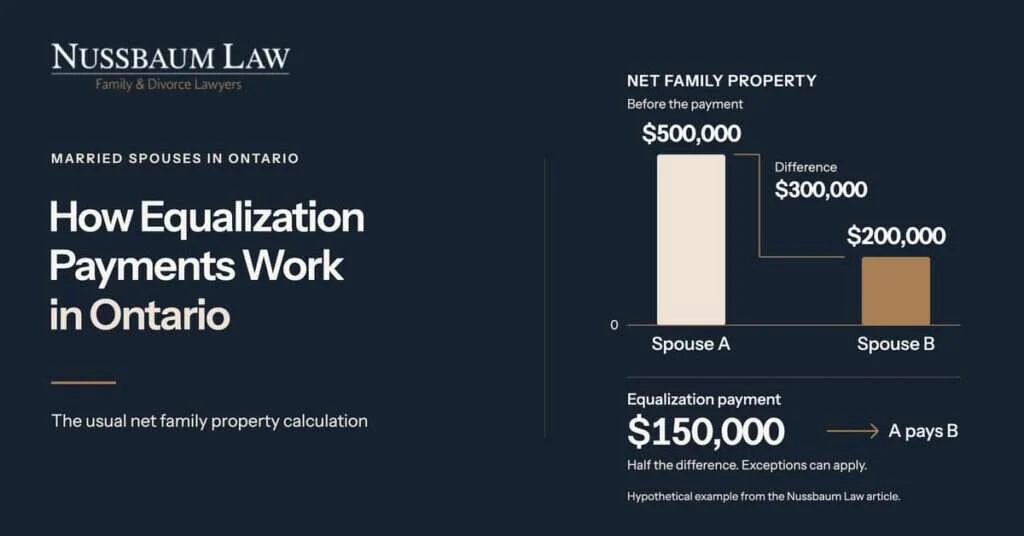


An equalization payment in Ontario usually gives the spouse with lower net family property half the difference between the two spouses’ amounts. Net family property accounts for property values, debts, permitted deductions and exclusions. The matrimonial home has special rules that can change the result.
A marriage contract or the statutory grounds for unequal division may affect the amount. Ontario’s property division rules for married spouses require more than adding up the assets each person owns.
The Net Family Property Formula Explained
Net family property represents wealth accumulated during marriage. Understanding this calculation is essential to knowing what you will owe or receive.
The Basic Formula
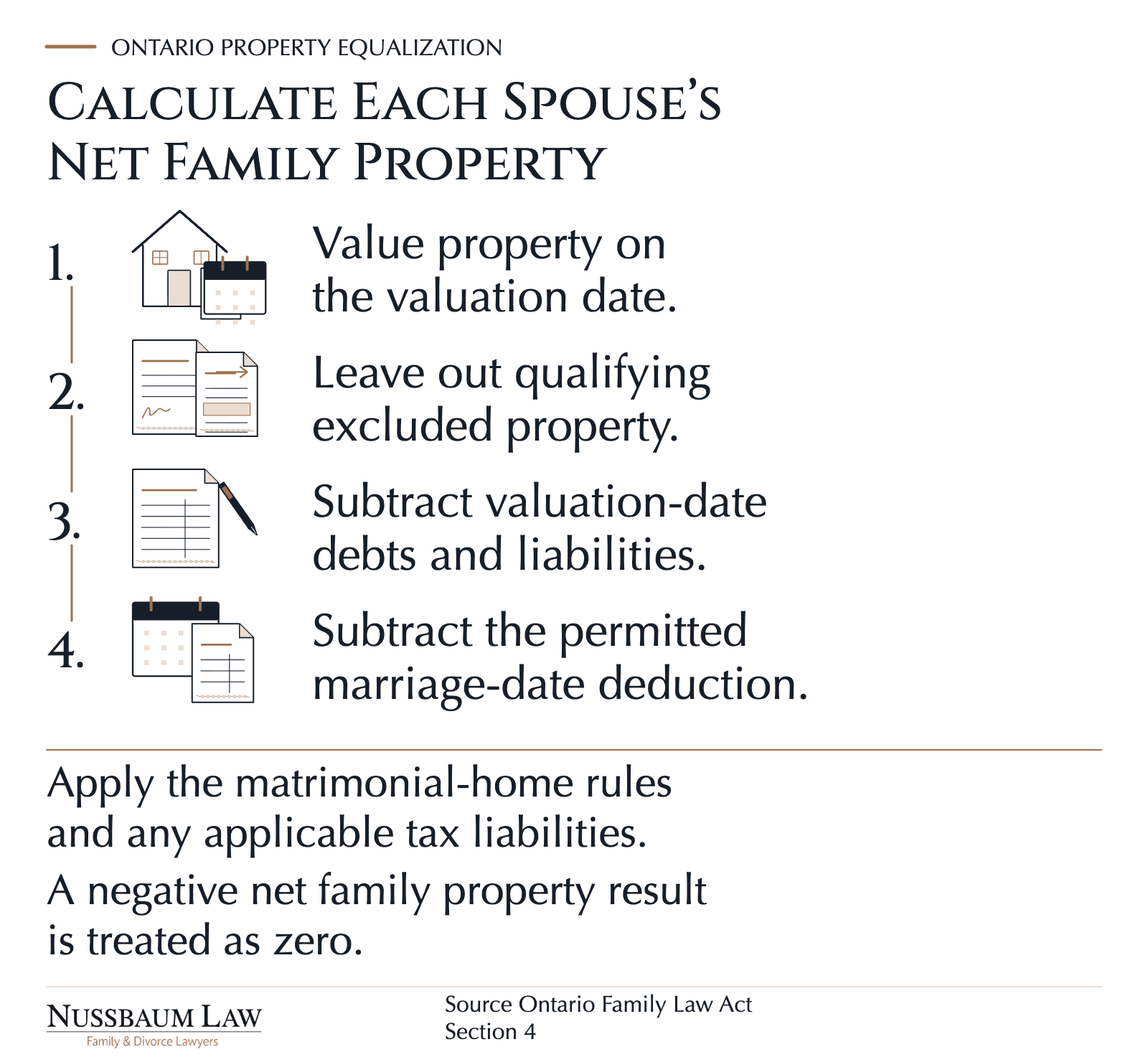
- Value the property you owned on the valuation date, leaving out property that qualifies for exclusion.
- Subtract debts and other liabilities as of that date, including applicable contingent tax liabilities.
- Use marriage-date property and debt values to determine the permitted deduction, applying the matrimonial-home exceptions.
- Net family property is the amount remaining after that deduction, with any negative result treated as zero.
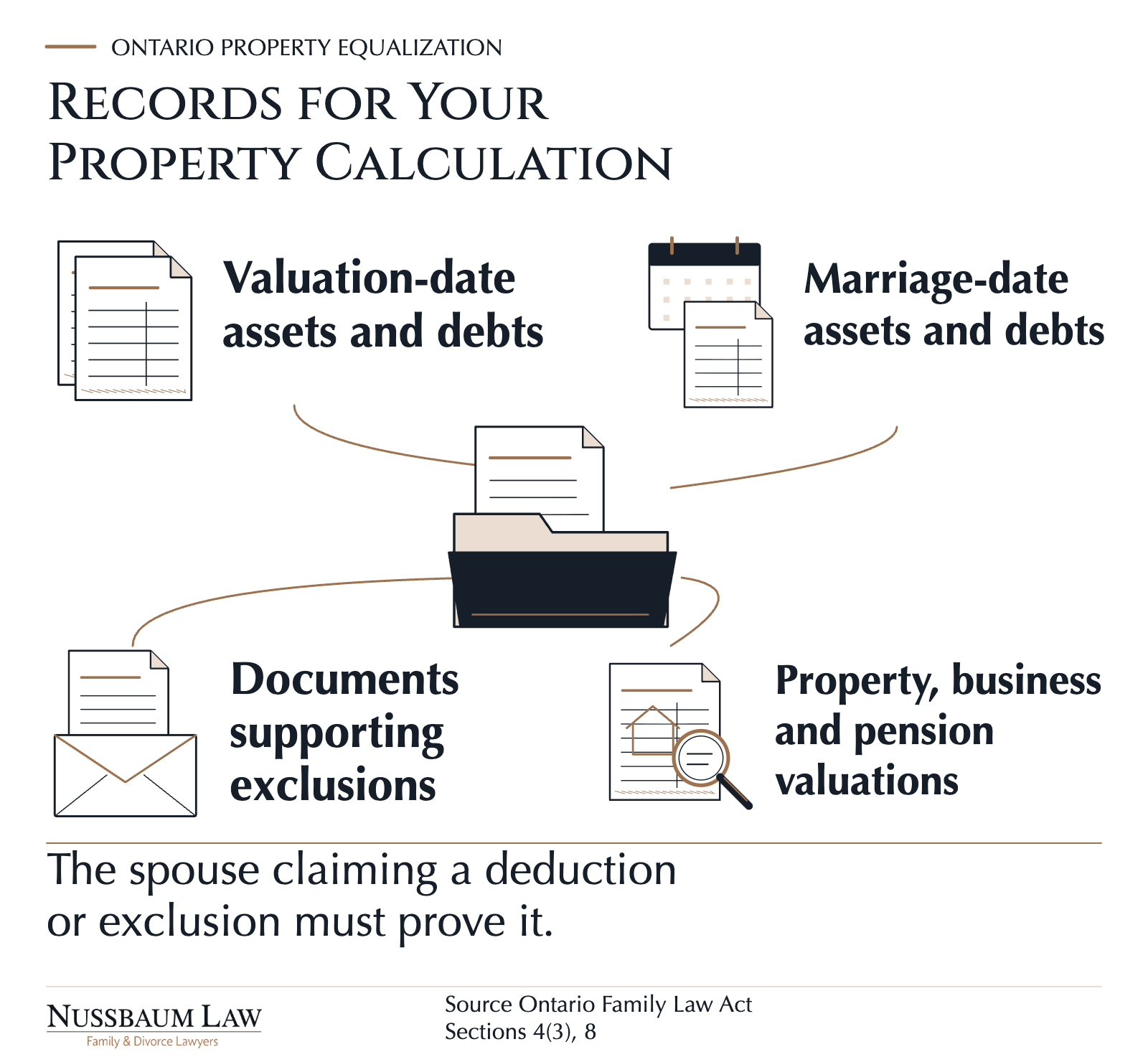
Section 4 of the Family Law Act defines these deductions and exclusions. The spouse claiming one must prove it.
Critical Dates That Determine Values
Ontario law requires calculations as of two specific dates.
-
- Marriage date. Establishes your financial starting point and what assets you can deduct
-
- Separation date. Captures your financial position when the relationship ended
Wealth accumulated between these dates gets divided equally through equalization. Any assets acquired before marriage (except the matrimonial home) reduce your net family property. Any assets acquired after separation do not count.
How Payment Amount Is Determined
After both spouses calculate their net family property.
-
- Subtract the smaller net family property from the larger amount
-
- Divide the difference by two
-
- The spouse with higher net family property pays this amount to the other spouse
Example in simple terms. If your net family property is $500,000 and your spouse’s is $200,000, the difference is $300,000. You pay half that difference, $150,000, to your spouse.
The Matrimonial Home Exception
The matrimonial home receives unique treatment under Ontario family law. This rule affects thousands of dollars in calculations.
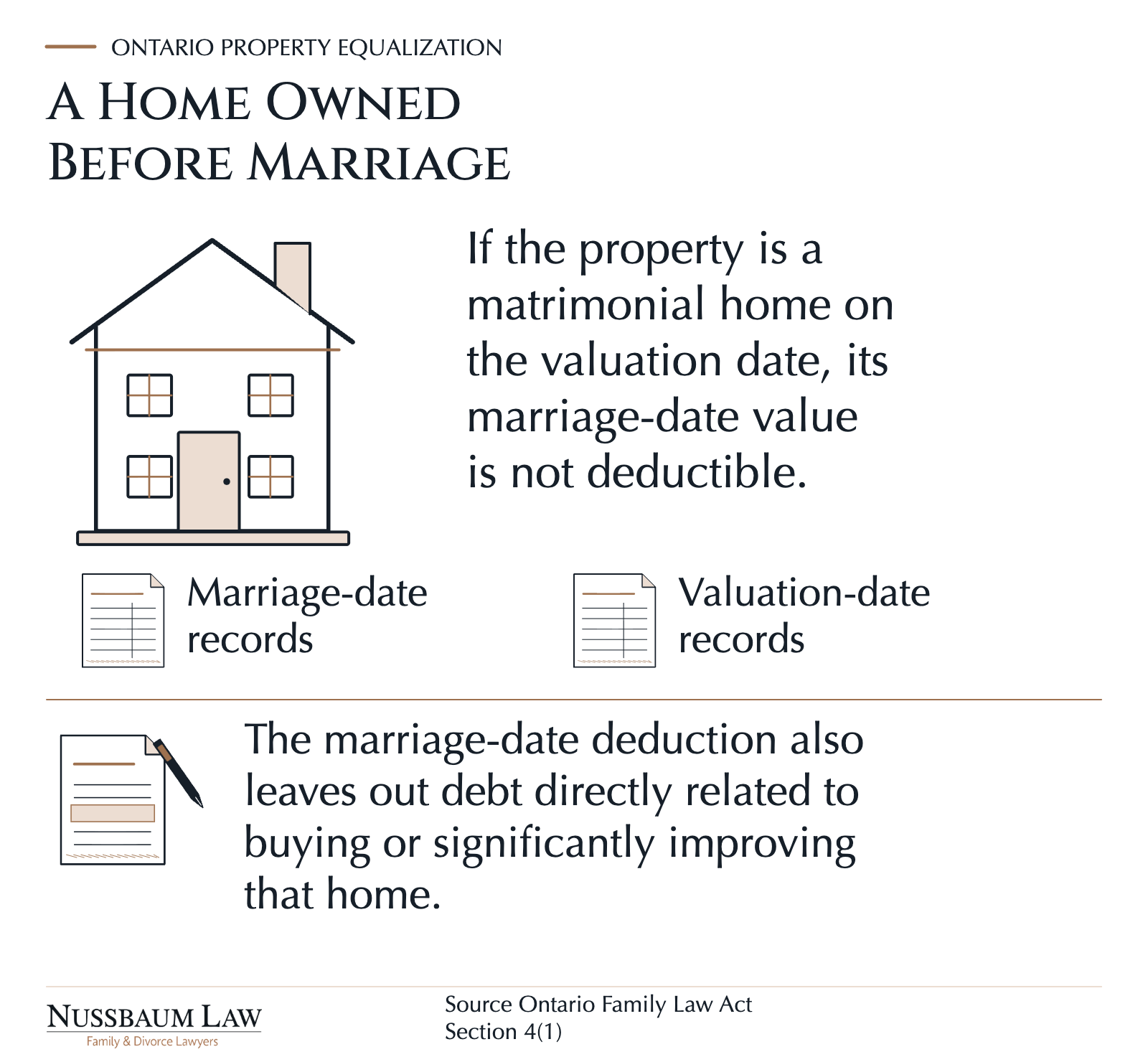
The rule. If you owned your home before marriage, you cannot subtract its pre-marriage value when calculating net family property. This applies even when one spouse owned the home outright before marriage.
What a Home Owned Before Marriage Adds to the Calculation
In a hypothetical example, you purchased a home for $300,000 three years before marriage. During your marriage, the home appreciated to $600,000 by separation.
Your net family property calculation includes the full $600,000 value. You cannot deduct the $300,000 pre-marriage value because the property became the matrimonial home.
This rule recognizes both spouses’ contributions to maintaining the family home during marriage, regardless of who held title before the wedding. It’s one of several special protections the matrimonial home carries in Ontario. For the full picture, including what happens to the family home in a divorce, whether or not you’re on the title, and how a sale or buyout actually works.
What Assets Get Included in Equalization
The Family Law Act defines which assets count toward net family property. Most property acquired during marriage gets included.
These assets always count in your calculation.
-
- Real estate. The matrimonial home and any other property you own, including cottages, rental properties, and vacant land.
-
- Bank accounts and investments. Savings, chequing accounts, GICs, stocks, bonds, mutual funds, and investment portfolios.
-
- Registered accounts. RRSPs, RRIFs, TFSAs, and other registered savings vehicles.
-
- Pensions. Workplace pension plans get valued based on the portion earned during marriage.
-
- Business interests. Shares in corporations, partnership interests, and sole proprietorship assets.
-
- Personal property. Vehicles, jewelry, furniture, electronics, and other tangible items owned on separation date.
Courts value these assets at fair market value as of your separation date. Fair market value means the price a willing buyer would pay a willing seller in an open market.
What Gets Excluded from Net Family Property
Ontario family law excludes specific types of property from equalization calculations. These exclusions protect inheritances, gifts, and personal injury awards received during marriage.
The Four Main Exclusions
These categories get excluded from your net family property when calculating equalization.
-
- Gifts and inheritances from third parties. Money or property you received as a gift or inheritance during marriage stays excluded if kept separate from marital assets.
-
- Personal injury awards. Compensation for pain and suffering or bodily injury gets excluded from equalization.
-
- Life insurance proceeds. Insurance payouts received upon someone’s death remain excluded.
-
- Property traceable to excluded assets. When you use excluded property to purchase other assets with clear documentation, those new assets may also be excluded.
The Separation Requirement
Excluded property loses its protected status when mixed with marital assets. If you received a $100,000 inheritance and deposited it into a joint account used for household expenses, the money gets included in your net family property.
To maintain exclusion protection.
-
- Keep inherited or gifted property in separate accounts under your name only
-
- Never mix excluded funds with joint accounts
-
- Maintain detailed records showing the source of funds
-
- Document any property purchased with excluded funds
-
- Keep bank statements and inheritance documentation
Step-by-Step Equalization Calculation
The following examples are hypothetical. They assume the stated values are accepted and there are no other assets, debts, exclusions or applicable tax adjustments.
Example One With a Jointly Owned Home
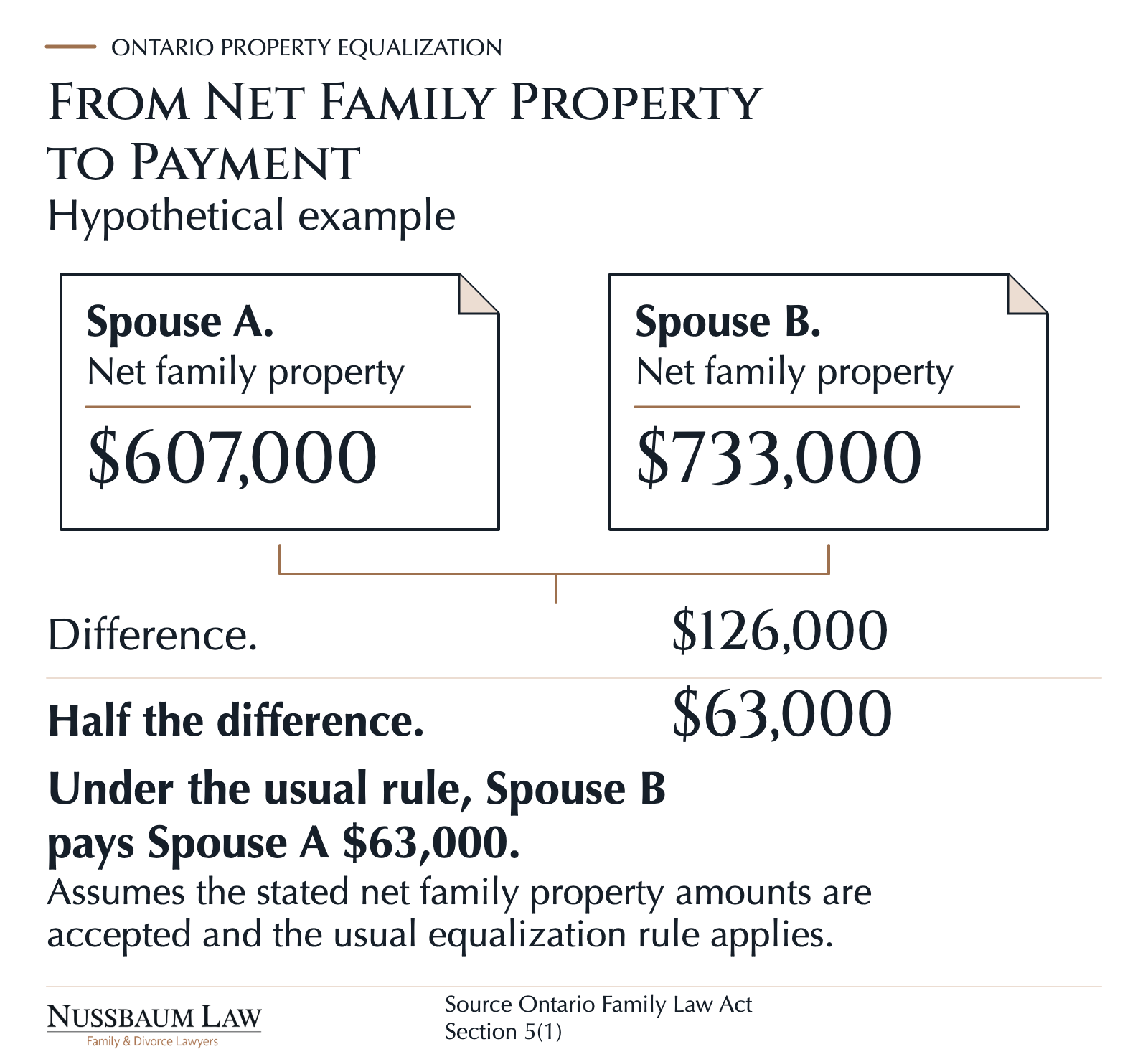
One spouse owns a $400,000 share of the matrimonial home, a $180,000 RRSP, a $30,000 vehicle and $45,000 in savings. These assets total $655,000. Subtracting $15,000 of debt and a permitted $33,000 marriage-date deduction gives net family property of $607,000.
The other spouse owns a $400,000 share of the home, a $95,000 RRSP, a $220,000 family-law pension value and $65,000 in investments. These assets total $780,000. Subtracting $30,000 of debt and a permitted $17,000 marriage-date deduction gives net family property of $733,000.
The difference is $126,000. Under the usual equalization rule, the spouse with $733,000 pays half that difference, or $63,000.
Example Two With a Home Owned Before Marriage
One spouse owns a home worth $700,000 on the valuation date, a $140,000 RRSP and $200,000 in business shares. The property total is $1,040,000. A $180,000 mortgage reduces it to $860,000.
On the marriage date, that spouse owned $60,000 in RRSPs and $80,000 in business shares. The home was worth $350,000 and had a $280,000 mortgage used to acquire it. It remains the matrimonial home on the valuation date.
Which Marriage-Date Values Can You Deduct?
The marriage-date deduction excludes the home and its acquisition mortgage. The permitted deduction in this example is therefore $140,000. Subtracting it from $860,000 gives net family property of $720,000.
The $720,000 is this spouse’s net family property. The other spouse’s net family property is still needed to calculate the equalization payment.
The treatment of marriage-date property and home-related debt follows the statutory definition of net family property.
Common Calculation Mistakes That Cost Money
Three errors appear repeatedly in equalization disputes. Each can shift your payment by tens of thousands of dollars.
Using Wrong Valuation Dates
Ontario family law requires assets be valued as of your separation date, not your divorce date or trial date. When spouses disagree about the separation date, valuations can shift by hundreds of thousands of dollars.
In a hypothetical example, a business rises in value by $180,000 between two disputed valuation dates. If that is the only change to the spouses’ net family properties, the usual half-difference calculation changes by $90,000.
How to protect yourself.
-
- Document your separation date through text messages, emails, or moving receipts
-
- Obtain asset valuations promptly after separation
-
- Keep records showing when you stopped living together as spouses
Forgetting Marriage Date Deductions
You can deduct assets owned on your marriage date from your net family property calculation. Many people forget to document these assets or fail to claim the deduction, which increases their net family property and raises their payment.
What to document.
-
- Bank account statements from your marriage date
-
- Investment account balances as of that date
-
- RRSP statements showing pre-marriage contributions
-
- Pension statements documenting pre-marriage service
-
- Vehicle ownership records and fair market values
Missing Hidden or Undervalued Assets
Some spouses undervalue assets or hide property to reduce their equalization payment. Common tactics include transferring assets to family members, undervaluing business interests, or failing to disclose investments.
Ontario family law requires full financial disclosure through sworn Financial Statements. When one spouse suspects hidden assets.
-
- Bank records can show unexplained transfers
-
- Business valuations reveal actual worth
-
- Credit reports identify undisclosed accounts
-
- Tax returns may show unreported income or investments
Payment Timeline and Enforcement
An equalization entitlement can arise when spouses separate with no reasonable prospect of resuming cohabitation. The amount and payment terms may be settled by agreement or court order. Interest can depend on the applicable law, the relevant dates and the terms of the order or agreement.
Payment Methods
Most equalization payments occur through one lump sum payment. The paying spouse transfers the full amount, often through.
-
- Sale of the matrimonial home with proceeds split appropriately
-
- Refinancing property to extract equity
-
- Liquidating investments or RRSPs
-
- Transferring property ownership directly to the receiving spouse
When the paying spouse cannot access sufficient funds immediately, courts may allow payment over time with interest charges on the outstanding balance. Payment plans require court approval.
Enforcement Options
When a spouse refuses or fails to make the required equalization payment, Ontario law provides enforcement mechanisms.
-
- Property liens. Register a lien against the other spouse’s property, preventing its sale until payment occurs
-
- Wage garnishment. Redirect income to satisfy the debt through court order
-
- Asset sales. Court-ordered sale of property to generate payment funds
-
- Contempt proceedings. In cases of deliberate evasion, courts can order jail time
Schedule Your Property Division Consultation
Equalization payment calculations determine who owes whom and how much in every Ontario divorce. These calculations require accurate asset valuations, proper documentation of marriage date values, and correct application of the Family Law Act’s exclusion rules. Mistakes in any area of the calculation can cost you thousands of dollars.
At Nussbaum Law, we calculate net family property for clients throughout Toronto, Vaughan, and Brampton. We review financial disclosure, identify hidden assets, and ensure you receive your fair share of marital property.
Whether you expect to receive payment or owe payment, understanding your exact financial position helps you negotiate effectively and avoid costly errors. Contact us for a consultation to review your specific situation and determine your net family property accurately.
Equalization Payment FAQs
Does the higher earner always pay equalization in Ontario divorce?
Equalization compares the spouses’ net family properties. A higher earner may receive a payment if their net family property is lower. Property exclusions, debts and permitted deductions must be accounted for before the amounts are compared.
A higher income alone does not establish who owes equalization. An inheritance may qualify as excluded property, so its treatment must be checked before it is included in net family property.
Can you avoid equalization payment by transferring assets before separation?
You cannot avoid equalization payment by transferring assets before separation. Ontario family law treats pre-separation asset transfers as fraudulent conveyances when done to defeat a spouse’s property rights.
Courts can reverse transfers made to family members or friends, add transferred property value back into your net family property calculation, and order you to pay costs for attempting to hide assets.
Courts examine transfers made in the two years before separation with particular scrutiny. When you transfer property for significantly less than its value or to people you know personally, those transactions get reversed.
What is the deadline to claim equalization in Ontario?
The deadline to apply for equalization is different from the date a payment is due. Under section 7(3) of the Family Law Act, the application deadline is the earliest of these dates.
- Two years after the marriage ends by divorce or a judgment of nullity.
- Six years after separation with no reasonable prospect of resuming cohabitation.
- Six months after the first spouse’s death.
When Can a Court Extend the Deadline?
A court may extend a prescribed time on motion under section 2(8). There must be apparent grounds for relief.
Relief must be unavailable because of delay incurred in good faith. No person may suffer substantial prejudice because of that delay.
An extension is not automatic. An Ontario family lawyer can check the relevant dates and any grounds for an extension before you rely on a deadline. The payment schedule depends on the applicable agreement or court order.
What happens to equalization if assets increase in value after separation?
Assets that increase in value after separation do not affect equalization calculations in Ontario. The net family property calculation uses asset values as of your separation date.
Post-separation appreciation belongs entirely to the spouse who owns the asset. When a spouse keeps the matrimonial home after separation and it increases in value by $200,000 before the divorce finalizes, that appreciation is not shared.
This rule protects both spouses’ post-separation financial independence. The separation date freezes your respective property interests at that moment in time.
How do you value a pension for equalization purposes?
You value a pension for equalization purposes by calculating the commuted value as of the separation date. The commuted value represents the lump sum needed today to provide the future pension payments you earned during marriage. Pension administrators provide commuted value statements showing this calculation.
Only the portion of pension earned during marriage gets included in net family property. If you worked twenty years total but were married for twelve of those years, twelve-twentieths of your pension’s commuted value gets included in your net family property.
What if your spouse refuses to provide financial disclosure for equalization?
When your spouse refuses to provide financial disclosure for equalization, you can bring a court motion to compel disclosure. Ontario family law requires both spouses to complete sworn Financial Statements and provide supporting documentation including tax returns, bank statements, investment records, and property valuations.
Non-compliant spouses face consequences including cost penalties, negative inferences about hidden assets, and potential contempt findings. Judges can assume undisclosed assets exist and increase that spouse’s net family property by estimated amounts. If your spouse refuses disclosure, document your requests and bring a motion promptly.