

You paid part of the mortgage. You helped renovate the home. You may have raised children, supported your partner’s business, or used your own income to keep the household running. Then the relationship ends, and the house is still in your partner’s name.
Do you get half?
In Ontario, the answer is not automatic. Common law property rights Ontario rules do not work the way married couples’ rights do, and that difference can cost you tens of thousands of dollars if you do not understand it before you separate. You may have a claim, but the claim depends on evidence, contributions, and the way the relationship was actually organized.
Common law property rights Ontario questions usually start with ownership, contributions, and evidence, not an automatic 50/50 split. Common-law partners in Ontario have no automatic right to an equal division of property when they separate. What you may have is a claim for compensation or, in some cases, an interest in a specific asset. This common law property rights Ontario article walks through what you are actually entitled to, how unjust enrichment and constructive trust claims work, what evidence courts look at, and how to protect yourself before a relationship ends.
Do common law couples split property equally in Ontario?
Ontario’s Family Law Act gives married spouses an equalization of net family property when they divorce. Each spouse’s property growth during the marriage is added up, and the spouse with the larger increase generally pays the other half the difference. That regime is for married couples only.
Common-law partners are left out of it. No matter how long you lived together, you do not automatically share in property titled in your partner’s name, and the family home gets no special protection the way a married couple’s matrimonial home does. If the house is in your partner’s name alone, the starting point is that it is your partner’s house. For common law property rights Ontario analysis, your next question is whether you have a claim against that ownership, not whether the law automatically gives you half.
This is the single most misunderstood point in Ontario family law, and it is worth understanding the legal difference between marriage and common law before you make any decisions. CLEO’s public legal education resource on property division for common-law couples explains the same core distinction: common-law partners usually keep the property they own separately, while jointly owned property is divided or shared. The absence of automatic equalization does not mean you walk away with nothing. It means common law property rights Ontario claims usually come from a different body of law: the law of unjust enrichment.
When can unjust enrichment apply after common law separation?
Unjust enrichment is the main route a common-law partner uses to claim a share of property after separation. A court can order one partner to compensate the other when one person has been enriched at the other’s expense without a fair reason for it.
To succeed, you generally have to show three things:
- Enrichment. Your partner received a benefit, such as money, labour, or improvements to their property.
- Deprivation. You suffered a corresponding loss, such as unpaid work, contributed income, or foregone career opportunities.
- No juristic reason. There was no contract, gift, or legal obligation that explains why your partner should keep the benefit for free.
The Supreme Court of Canada’s decision in Kerr v. Baranow shaped how these claims are decided. Where two people ran what the court called a "joint family venture," sharing their lives and finances toward a common goal, a partner may be entitled to a share of the wealth built during the relationship, proportionate to their contribution. Caregiving, running the household, and supporting a partner’s business all count as contributions, not just cash.
When can a constructive trust claim give you an interest in property?
When money is not enough to fairly fix the imbalance, a court can go further and grant a constructive trust. Ontario claimants use this remedy to ask for an actual ownership interest in a specific piece of property. In a constructive trust Ontario claim, the key question is whether your contribution is tied closely enough to the property to justify more than a money award.
A constructive trust may be available when your contribution is closely tied to a particular asset, often the home, and when a money award alone would not do justice. For example, if you spent years and your own savings renovating a property your partner holds title to, a court could recognize that you hold a beneficial interest in it.
Constructive trust is powerful, but it is not simple and it is never guaranteed. You have to connect your contribution to the asset and show that monetary compensation would be inadequate. Because these claims turn on the specific facts and the documents you can produce, it is worth speaking with a property division lawyer early, while the evidence is still fresh.
What evidence courts look at
Common-law property claims are won and lost on evidence. The more you can document, the stronger your position. In common law property rights Ontario disputes, courts typically consider:
- Financial contributions: deposits, mortgage or rent payments, property tax, major bills, and shared loans.
- Improvements and labour: renovations, repairs, and physical work that increased the value of your partner’s property.
- Caregiving and household work: raising children and running the home so your partner could earn or build a business.
- Business support: unpaid work in a partner’s company, or income you put in to keep it running.
- Shared finances: joint accounts, jointly held assets, and how the two of you actually managed money.
- Promises and agreements: texts, emails, or written notes where your partner acknowledged your stake.
Keep records. Bank statements, receipts, photos of work done, and written communication are often more persuasive than memory.
How to protect yourself before separation
The cleanest way to avoid an expensive, uncertain claim is to deal with property while the relationship is healthy. Property division common law Ontario disputes are easier to prevent than to litigate after records disappear and both sides remember the same years differently. A few practical steps make a real difference:
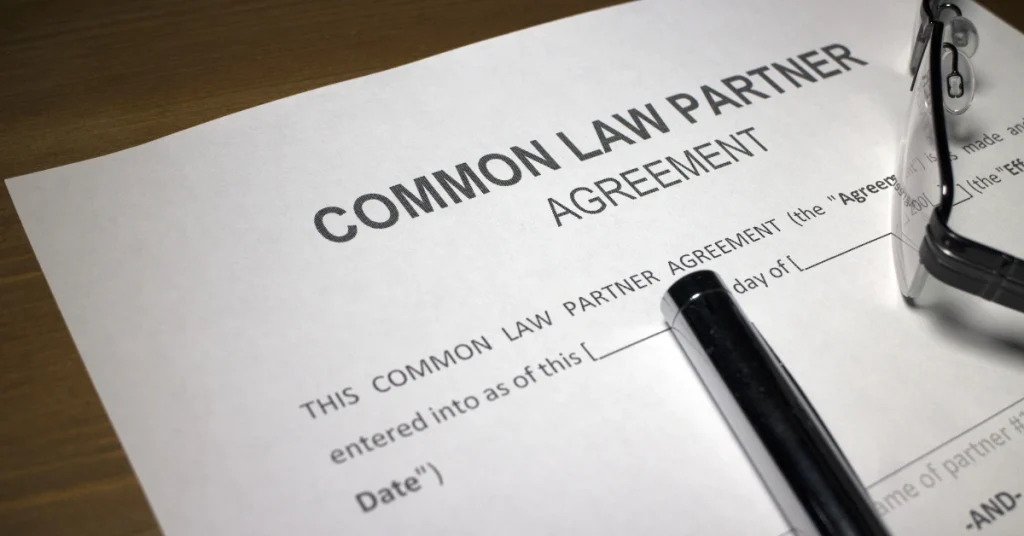
- Sign a cohabitation agreement. A cohabitation agreement lets you and your partner set out who owns what and how property would be divided if you separate. It is the closest thing common-law couples have to certainty.
- Be clear about title. If you are contributing to a home, consider whether you should be on title, and get legal advice before transferring or improving property you do not own.
- Keep your own records. Track what you contribute, in money and in work.
- Get advice early. A short consultation before a problem becomes a dispute is far cheaper than litigation later.
Frequently asked questions
Do common law spouses split property 50/50 in Ontario?
No. There is no automatic equal split for common-law couples in Ontario. Equalization under the Family Law Act applies only to married spouses. A common-law partner can pursue a claim through unjust enrichment or constructive trust, but the result depends on documented contributions, not a 50/50 default.
What is unjust enrichment?
Unjust enrichment is a legal claim that one partner was enriched at the other’s expense with no fair reason. You generally have to show your partner gained a benefit, you suffered a matching loss, and there was no contract or gift explaining it. If the claim succeeds, a court can order compensation or an interest in property.
What is a constructive trust?
A constructive trust is a court-ordered ownership interest in a specific asset, usually the home, granted when a money award would not be enough to fairly recognize your contribution. It is fact-specific and has to be tied to the property in question.
Can a cohabitation agreement protect property?
Yes. A properly drafted cohabitation agreement can set out ownership and division terms in advance, which gives common-law couples far more certainty than relying on a court claim after separation.
Talk to a property division lawyer
Common-law property disputes in Ontario are decided on facts and evidence, and the outcomes vary widely. If you are separating from a long-term partner and you are unsure what you are entitled to, common law property rights Ontario advice can help you avoid decisions you cannot reverse. A lawyer can assess common law property rights Ontario claims before you accept a settlement, leave a home, or give up records that may matter later. Book a free consultation with Nussbaum Law to understand your options and protect what you have built.
—