



Two spouses. One marriage. And an $80,000 disagreement that had nothing to do with money itself. It came down to a single date.
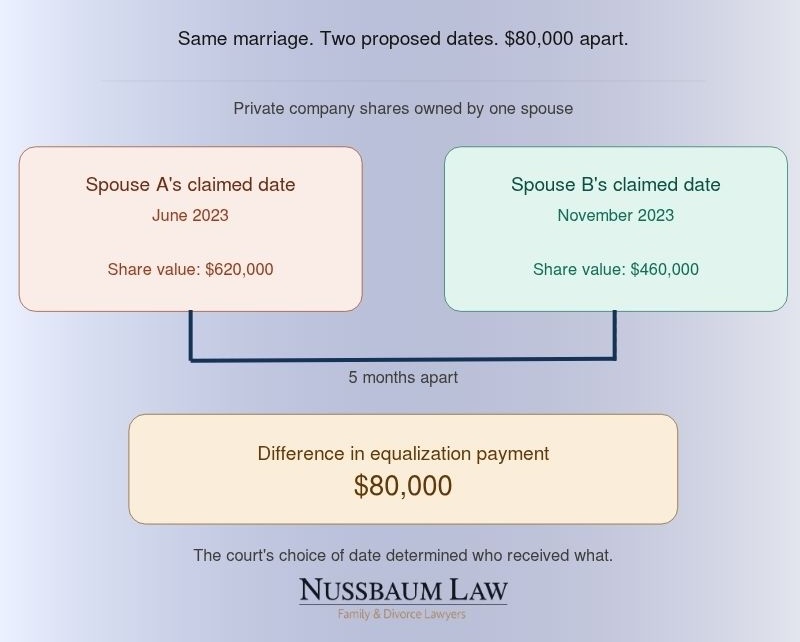
A couple I worked with disputed their date of separation Ontario by just over five months. One spouse owned shares in a private company. The other claimed a separation date when those shares were worth considerably more. Five months later, the valuation had dropped. What each spouse would receive came down entirely to which date the court accepted.
Your date of separation in Ontario is the day both spouses decided, or one spouse decided and communicated, that the marriage was over. People confuse this with the day someone moved out or the day you filed for divorce. Neither of those is correct. Under Ontario’s Family Law Act and Divorce Act, this date controls the value of property subject to division, when support obligations begin, and how assets acquired after that date are treated.
When both spouses agree on this date, the process moves forward with far less friction. When they don’t, a judge decides. The outcome can shift tens of thousands of dollars in either direction.
What “Living Separate and Apart” Actually Means in Ontario
Most people assume separation requires one spouse to leave the home. That assumption costs people money in court.
Ontario law recognizes that spouses can live separately and apart under the same roof. The Divorce Act doesn’t require physical separation. What it requires is an intention to separate, combined with conduct that reflects that intention.
Courts look at the whole picture of how two people are living. Separated spouses sharing a home can still qualify as legally separated, but the evidence has to line up across several areas of daily life.
Sleeping arrangements are usually the first thing a court asks about. Are both spouses still sharing a bedroom, or have they moved to separate rooms on a consistent basis?
The couple’s social life matters too. If you’re still going to dinner parties together, still showing up to family events as a unit, courts will question whether the marriage has actually ended. On the flip side, if friends and relatives already know you’ve split, that carries weight.
Finances tell a clear story. Have the bank accounts been divided? Has one spouse stopped contributing to household bills? Are the joint credit cards still being used jointly? Courts pay close attention here because financial records don’t lie, and they come with dates attached.
Physical intimacy has to have ended. This factor rarely generates much courtroom debate on its own, and proving it almost never relies on direct evidence. It matters as part of the overall picture, but a judge isn’t going to decide the separation date based on this alone.
How the household actually runs, day to day, tells courts more than most people expect. Who’s buying the groceries? Who’s cooking dinner? Is someone still doing the other person’s laundry? If both spouses are still operating like a domestic unit, splitting chores and eating meals together, that undercuts a claim of separation. What courts want to see is that each person started managing their own daily life. Separate meals. Separate shopping trips. Two people living under one roof but running two separate households.
Then there’s the question of whether anyone outside the home knew the marriage was over. A phone call to a parent on a Tuesday night. A text to a close friend. Even a passing comment to a coworker at lunch. Courts take this seriously because once the separation has been acknowledged to someone outside the relationship, it’s much harder for the other spouse to claim it hadn’t happened yet. People tend to underestimate this one, but it can carry real weight at trial.
Here’s the thing, though. No single factor on that list will make or break the case. I’ve seen couples who still ate together a few times a week get recognized as separated because everything else in their lives had clearly split apart. Courts weigh the full pattern of conduct, and they’re looking for whether the marriage ended in substance, even if both people still share an address.
How the Separation Date Affects Your Divorce in Three Concrete Ways
Property Valuation Date
The Family Law Act ties equalization of net family property to the valuation date, and that valuation date is your date of separation. Here’s how it works: each spouse’s net family property is calculated by taking what their assets were worth on that date, subtracting debts as of that same date, and subtracting whatever they brought into the marriage.
So a business, an investment portfolio, a pension, a house, all of it gets valued as of that one specific day. Markets move. Businesses grow or shrink. Real estate appreciates or drops. If the separation date is in dispute, the financial outcome of equalization shifts right along with it.
I’ve worked on high-asset files where a few months’ difference in the valuation date changed the equalization payment by tens of thousands of dollars. It happens more often than people realize.
Support Start Date
Child support and spousal support obligations are typically calculated from the date of separation. Courts can order retroactive support going all the way back to that date. A spouse who waited to file doesn’t lose their claim to support from the actual separation.
Where this gets contentious is when one party argues for a later date. The other party could lose months, sometimes years, of retroactive support entitlement. Retroactive child support claims under federal guidelines can reach back three years in certain circumstances, so the financial exposure adds up quickly.
Post-Separation Asset Treatment
Property acquired after the separation date is generally excluded from equalization. An inheritance that came in two months after separation? A year-end bonus? A new investment? None of that enters the equalization calculation if the separation date holds.
That’s why establishing the earliest defensible date protects post-separation gains. Whoever proves the earlier date may keep certain assets entirely outside the division.
How Ontario Courts Determine a Disputed Separation Date
When spouses can’t agree, courts piece together a timeline from whatever evidence both sides bring in. Five categories tend to carry the most weight, though they don’t all matter equally in every case.
1. Communication of Intent
Did one spouse tell the other, clearly and directly, that the marriage was over? Courts treat this as one of the most reliable indicators. A text message works. So does an email, a conversation in front of a witness, or a formal letter from a lawyer. The key is that the intent was communicated, not just felt privately.
2. Physical Changes to the Living Arrangement
Sleeping arrangements are a big one here. Courts want to know when they changed, when one spouse stopped contributing to household expenses, and when belongings got moved to a separate space. Even if both parties stayed under the same roof, there’s usually a moment where the physical structure of daily life visibly broke apart. That’s what judges look for.
3. Financial Separation
Bank records and credit card statements are hard to argue with, and courts know it. A joint account that suddenly stops seeing deposits from one spouse, a new individual account opened on a specific date, a credit card removed from a partner’s name. These records create an objective timeline that witnesses and memory can’t match. I’d go as far as saying financial evidence is the single strongest category in most disputed cases.
4. Social and Family Acknowledgment
This one plays out differently than the others. It’s less about what happened between the two spouses and more about what the outside world knew. When did friends find out? Did family members hear about it on a specific date? Were there social media posts, canceled holiday plans, conversations with mutual friends? Witnesses who can say “she told me on March 14th that the marriage was over” give courts something concrete to anchor the timeline to.
5. Third-Party Documentation
Therapy notes, counselling intake forms, a consultation with a lawyer, emails to a mediator. Any documentation created by a professional at or near the time of separation carries weight because it wasn’t created for litigation. It was created in the moment, and courts treat it as a more honest reflection of what was happening than anything either party reconstructs years later in a courtroom.
What Changes Financially After the Separation Date
The separation date doesn’t just affect how assets get divided. It also changes the financial obligations running between spouses, and some of those changes catch people off guard.
Joint debts are a good example. Separating doesn’t release either spouse from a joint account. If both names are on the debt, both people owe it until the account is closed or restructured. Creditors don’t care what your separation agreement says. They’ll pursue whoever’s name is attached. The mortgage follows the same logic, and I’ve had clients assume they stopped owing once they moved out of the house. That’s wrong. Both names on the mortgage, both parties liable to the lender. Full stop.
On the other side of the ledger, anything acquired after the separation date is generally excluded from equalization. Inheritances, investment gains, new property. None of it enters the calculation if the separation date holds. That’s a significant reason to establish the earliest defensible date you can.
Support obligations are tied to the separation date as well, and courts can reach back. Child support and spousal support are both calculated from that date, including retroactively. People who wait months to file sometimes assume they’ve lost that period. They haven’t. The clock started when the separation happened, not when the paperwork did.
The one that gets overlooked most often, in my experience, is beneficiary designations. Wills, life insurance policies, RRSPs. None of these update automatically when you separate. If your ex-spouse is still named on a policy or registered account, that designation holds until you go in and change it. With everything else going on during a separation, this falls to the bottom of the list for most people, and that’s exactly why it’s worth handling early.
Documenting Your Separation Date: What Actually Holds Up in Court
If you’re separating, or if a dispute over the date seems possible, start building a paper trail now. Not next month. Now. Courts give far more weight to documentation created at the time of separation than to anything reconstructed after the fact.
Send your spouse an email or text that says you consider the marriage over. Keep a copy somewhere they can’t access or delete. That timestamped record alone puts you ahead of most people who come into my office without one.
Open a bank account in your name only, and write down the date you did it. Bank statements showing when the financial split started are some of the cleanest evidence a court can work with. If you have to pick one thing to do first, this is probably it.
Tell someone you trust, a parent, a sibling, a close friend, and make a note of the exact date. Most people don’t think about witness testimony until they need it. By then it’s too late to create it. Their ability to say “she called me on October 3rd and told me the marriage was over” can anchor your entire timeline.
Document every change to your living situation. Different bedroom? Write it down. One spouse moved out? Keep the lease, the utility transfer confirmation, the forwarding address paperwork. These details feel administrative in the moment, but they become evidence later.
Book a consultation with a family lawyer even if you’re not ready to file. The lawyer’s office documents that meeting independently, and that third-party record carries more credibility than anything you write in a personal journal. To be fair, a journal still matters. A few sentences each week about how things are operating at home, what was said, what changed. Dated notes written in real time hold up far better than trying to piece together a timeline two years into litigation.
Go through your financial accounts and record when you closed joint accounts, removed your spouse from credit cards, or changed direct deposit. Every one of those dates adds another anchor point to your timeline.
Retroactive Support and the Separation Date
Most people don’t realize a disputed separation date can change how much retroactive support they owe or receive. But it can, and sometimes by a lot.
Ontario courts can award child support retroactively. The Supreme Court of Canada confirmed this in DBS v SRG, holding that retroactive child support can be ordered going back to the date the need arose. Courts typically treat the separation date as that starting point. The general window is three years before the application was filed, though judges have discretion to extend it.
Spousal support works similarly, but with a different framework. The Spousal Support Advisory Guidelines use the separation date as a reference for both when support starts and, depending on the formula, how long it lasts. Claiming a later separation date can shrink the total support period.
And this cuts both ways. A payor who argues for a later separation date might reduce what they owe retroactively. A recipient who can prove an earlier date might increase both the total amount and the duration. I’ve seen files where the difference between two proposed dates changed the retroactive support obligation by over $20,000. The stakes aren’t theoretical.
Common Separation Date Disputes and How Courts Resolve Them
Attempted Reconciliation
Couples sometimes separate, try again, and separate a second time. The Divorce Act accounts for this. Up to 90 days of resumed cohabitation for reconciliation purposes won’t reset the one-year separation clock. If things don’t work out, the separation period continues from the original date.
Where it gets complicated is the question of whether the reconciliation was genuine. If the couple resumed living as spouses in a meaningful sense, sharing a bedroom, socializing together, operating as a unit, courts may decide the original separation ended and a new one began. A temporary reunion where both people knew it probably wasn’t going to last? That’s less likely to reset anything.
One Spouse Didn’t Know
This comes up more than you’d expect. One person internally decides the marriage is over, maybe years before anything changes on the surface. They don’t say it out loud. They don’t change the sleeping arrangements. They just quietly check out.
Courts won’t accept a claimed separation date from years ago if the other spouse had no reasonable way of knowing. You have to show that the other person understood, or should have understood, that the relationship had ended. Without objective evidence of that, the claimed date won’t hold.
Gradual Emotional Estrangement
Some marriages don’t end with a conversation or a slammed door. They fade. Two people living as roommates for years, barely speaking, no intimacy, no shared plans, but no one ever says the words “this marriage is over.”
These are the hardest cases to pin a date on. Courts look for a specific act or communication that marks the shift from unhappy marriage to legal separation. A first call to a lawyer. A conversation with a family member. A change in the bank accounts. Without at least one clear marker, judges have to reconstruct the timeline from fragments, and that reconstruction rarely favors the party who didn’t document anything.
Frequently Asked Questions
What is the date of separation in Ontario family law?
It’s the date both spouses decided the marriage was permanently over, or the date one spouse made that decision and communicated it. Under the Family Law Act, this date becomes the property valuation date. It also controls when support obligations kick in and which assets are subject to equalization. A common misconception is that the separation date is when someone physically moved out. Courts don’t see it that way. They look at evidence of intent, conduct, financial separation, and communication between the spouses.
Can spouses be separated while living in the same house in Ontario?
They can, and courts accept it more often than people think. The legal question is whether the marriage has ended in substance, even if both people still live at the same address. Courts look at whether sleeping arrangements have changed, whether finances are divided, whether the sexual relationship has ended, whether each person is living an independent social life, and whether at least one spouse has told others the marriage is over. Most couples who stay in the same home after separating do so because of financial pressure. As long as the evidence lines up consistently, courts will recognize an in-home separation.
How do I prove the date of separation in Ontario?
Documentation created at or near the time of separation is what carries the most weight. Emails or texts where you told your spouse the marriage was over give you a timestamped record. Bank records showing when accounts were split help establish a timeline. If you told a family member or friend on a specific date, their testimony can matter. Records from a first legal consultation, a lease agreement or utility bill in one person’s name, and dated journal entries all contribute. The court looks at how consistent and credible this evidence is, and weighs it against whatever the other side brings forward.
Does the separation date affect child support in Ontario?
It does, and significantly. Child support obligations begin at the date of separation, and courts can order retroactive payments going back to that date. The typical window for retroactive child support is up to three years before the application was filed. When the separation date is disputed, the outcome directly changes how much retroactive support gets owed. Under the Federal Child Support Guidelines, the clock starts when the parents separated. Getting that date right, and having documentation to support it, matters for both the payor and the recipient.
What happens if my spouse and I disagree on the separation date?
A court will decide for you based on whatever evidence both sides present. Each party puts forward their version of the timeline, backed by documents, financial records, and witness testimony. The court weighs communication of intent, changes in living arrangements, when finances were separated, and when friends or family learned the marriage was over. These cases are worth taking seriously because the financial consequences, both for property division and support, can be significant. Legal representation makes a real difference when the separation date is in dispute.
How a Family Lawyer Helps You Establish and Protect Your Separation Date
At Nussbaum Law, I’ve worked with clients where the separation date was the central dispute in an otherwise uncomplicated divorce. What looks like a factual disagreement is almost always a financial one.
The earlier you document your separation date and get legal advice, the stronger your position. Evidence created at the time of separation is far more credible than evidence reconstructed years later. A lawyer can help you figure out what documentation you already have, tell you what steps to take right away, and build the clearest possible timeline of your separation.
If you’re in the early stages of separation, or if you believe your spouse may dispute the separation date, contact Nussbaum Law for a consultation. The date you establish now will shape the financial outcome of your divorce.