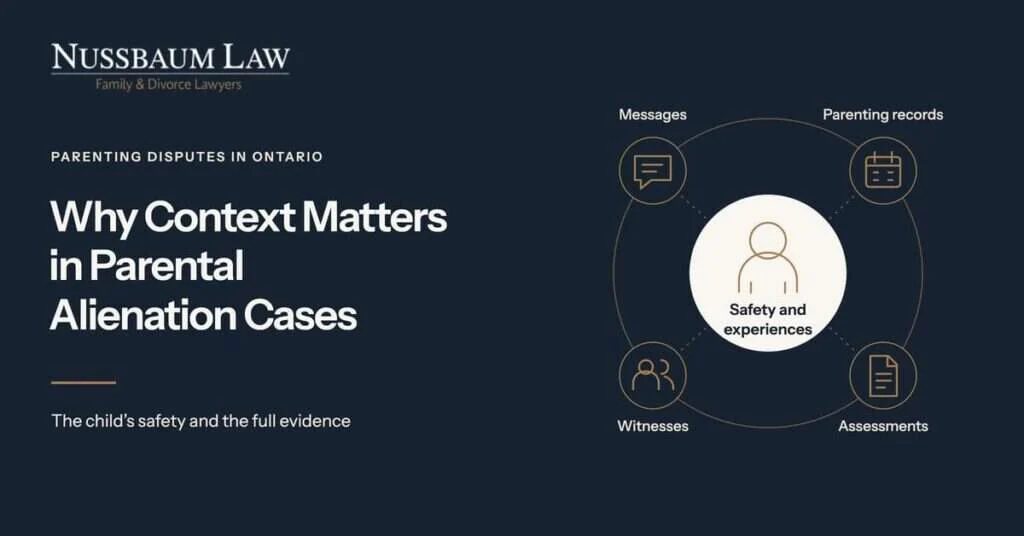


Evidence of parental alienation in Ontario must be assessed in the context of the child’s relationships and safety. A child’s reluctance to see a parent does not, by itself, establish alienation.
Keep dated records of disputed conduct and missed parenting time. Professional assessments or neutral witness evidence may help explain the child’s behaviour. The court considers the child’s best interests when deciding parenting arrangements.
A child’s refusal needs an explanation
A parent alleging alienation needs evidence of the conduct they say has harmed the parent-child relationship. Describe what happened, who observed it and how it affected the child. Calling the other parent an alienator does not establish those facts.
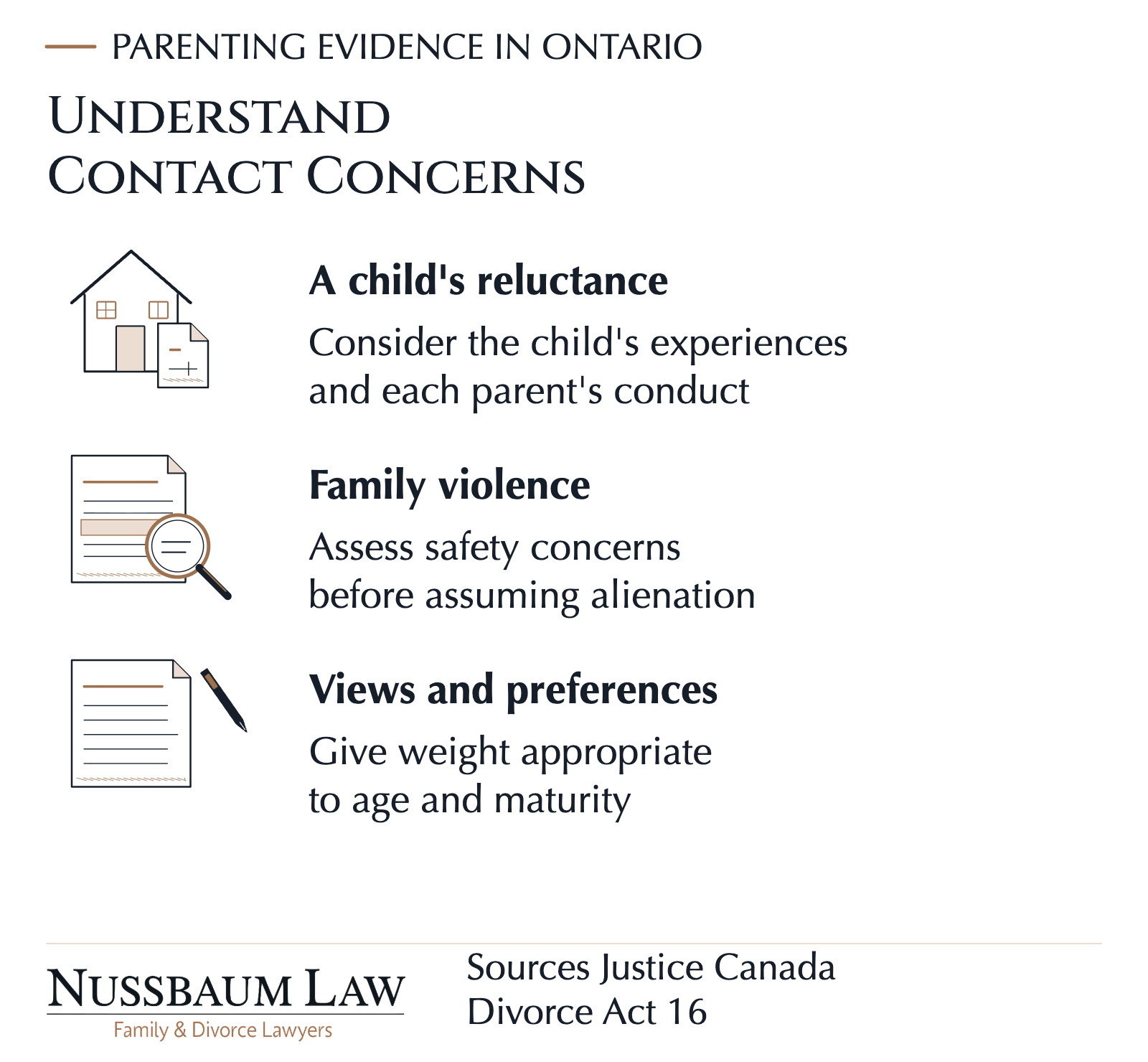
Children can resist contact because of family violence, conflict, poor parenting or other experiences. Justice Canada’s legal-adviser guidance explains why professionals must consider each parent’s conduct and the child’s own experiences when assessing a child’s rejection of a parent. An allegation of alienation must not displace an investigation into abuse or safety concerns.
Adult-sounding language, a missed visit or a change in affection cannot explain the cause on its own. A closed police or Children’s Aid Society investigation does not, by itself, establish that someone deliberately made a false allegation. Preserve the actual findings and their limits rather than attaching a stronger conclusion.
The child’s safety comes first
Under section 16 of the Divorce Act, parenting decisions turn on the child’s best interests. The court gives primary consideration to physical, emotional and psychological safety, security and well-being. Ontario’s Children’s Law Reform Act, section 24, sets out corresponding factors for proceedings under that Act.
The judge considers the child’s relationships, care history, needs and views, with weight appropriate to age and maturity. Each parent’s willingness to support the other parent-child relationship is relevant, alongside family violence and coercive control. The parenting-time principle remains subject to the child’s best interests.
Keep records that explain the disputed conduct
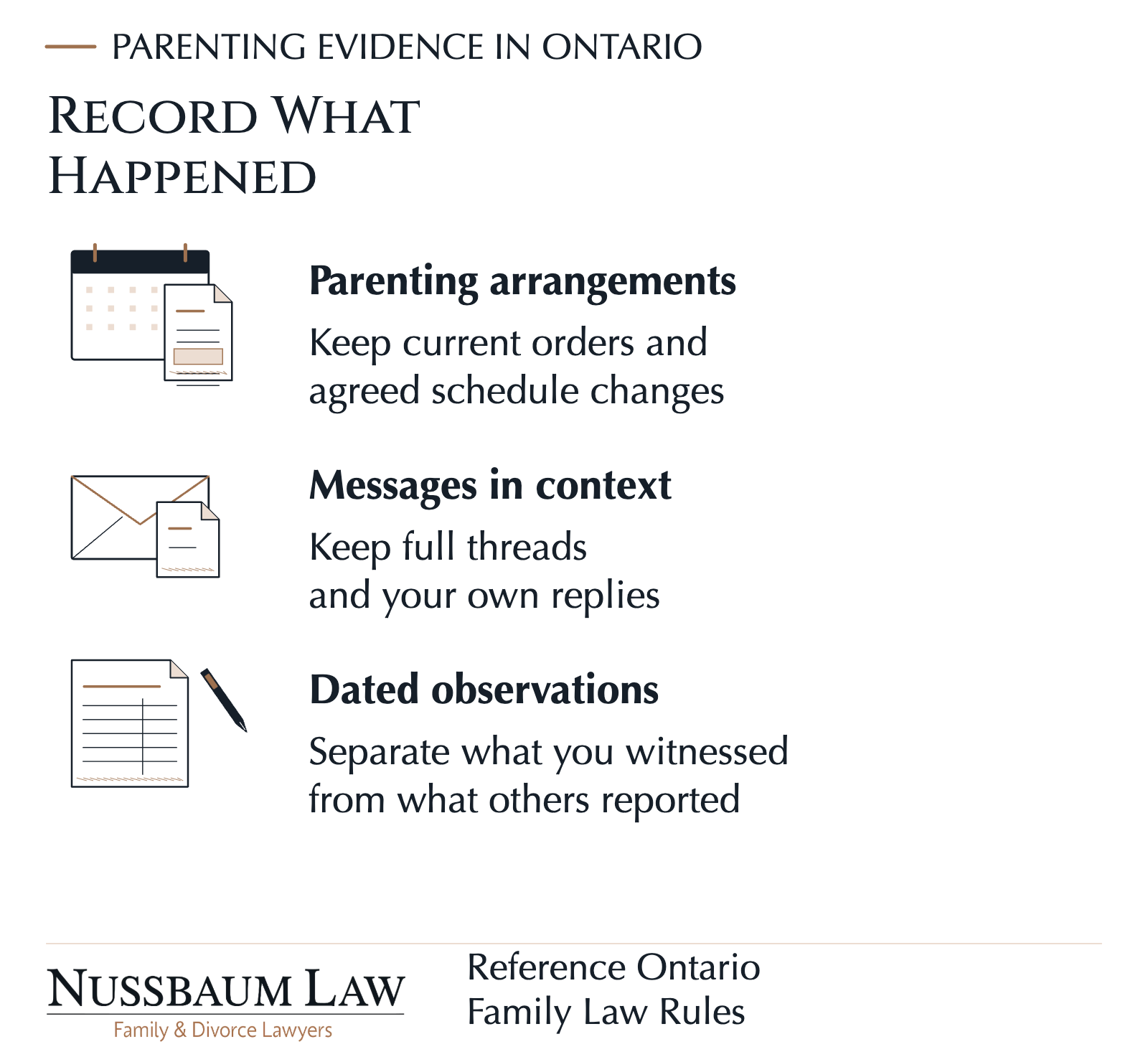
Start a dated chronology while events are fresh. Separate what you saw or heard from what another person reported and from your own interpretation. Include the explanation the other parent gave, even when you disagree with it.
- Parenting orders and agreements. Save the current schedule, communication terms and later written changes so a reader can identify what was expected.
- Missed or changed parenting time. Record the scheduled exchange, what happened, the stated reason and any proposed replacement time.
- Messages and emails. Keep complete conversations with dates, sender details and your own replies.
- School and health communications. Preserve relevant notices or requests for information that you can lawfully access.
- Witness details. Note who personally observed an exchange, comment or change in behaviour and how they can be contacted.
For a hypothetical cancelled exchange, record the agreed pickup time, the cancellation message and the explanation given. Include any offer to reschedule and your response. That record lets someone assess the incident without treating the cancellation as proof of its cause.
Compare events without assuming a cause
A chronology can reveal repeated interference, but timing alone does not prove intent or explain a child’s reaction. Record periods when arrangements worked as well as disputed events. Include relevant changes in health, school, living arrangements or safety concerns.
There is no universal number of incidents or months of records that establishes alienation. A serious incident may require immediate attention even when you have little documentation. Do not postpone a safety response to accumulate a longer history.
Text messages need their surrounding conversation
A message can help establish a refusal, an explanation or a proposed arrangement. It cannot automatically establish why a child resists contact. Save the original conversation or export where available, alongside screenshots that show who sent each message and when.
A cropped image may omit a later agreement, a safety explanation or your own response. Keep the unedited material and identify the relevant passages separately. Do not access another person’s private account or ask your child to retrieve messages for your case.
The same caution applies to social posts. Preserve material you can lawfully access, including its date and surrounding discussion, without publishing accusations or private family records yourself. A post’s relevance depends on what it establishes about the parenting dispute.
Witnesses should describe what they observed
A teacher might describe a child’s behaviour at school or a communication they received. A relative might describe an exchange they attended. Their usefulness depends on personal knowledge, detail and reliability, rather than a universal ranking of witness categories.
Identify the witness’s relationship to the family and any limits on their knowledge. A friend repeating your account has a different basis for their evidence from someone who saw the event. Avoid asking witnesses to diagnose alienation or adopt your wording.
A section 30 assessment has a defined purpose
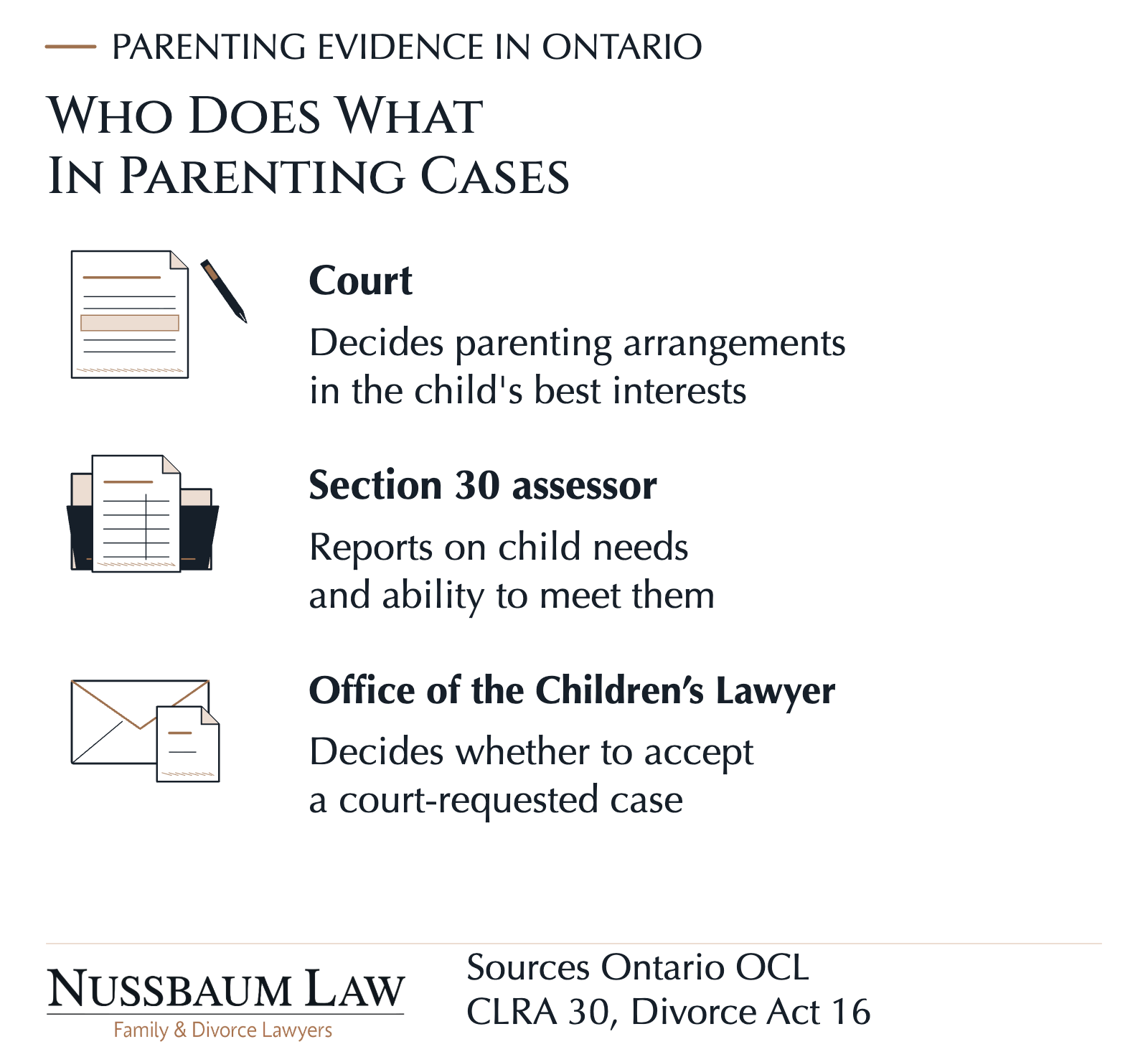
Under section 30 of the Children’s Law Reform Act, the court may appoint a person with technical or professional skill to assess the child’s needs. The assessor also reports on the parties’ ability and willingness to meet those needs. An assessment is not a compulsory step in every parenting dispute.
The assessment order and the professional’s methods determine the work required. The assessor may examine family relationships, records and competing explanations for contact difficulties. Where family violence is alleged, relevant expertise in violence and trauma is important to evaluating the child’s experiences.
A section 30 report is admissible in the application, and a party may require the assessor to attend as a witness. The judge decides what the report establishes in the case. Neither the appointment nor the report guarantees a finding of alienation or a change in parenting arrangements.
Confirm the scope, fees and reporting date
Section 30 requires the assessor to consent to reporting within the period specified by the court. The court also specifies the parties’ shares of the fees and expenses, with possible relief for serious financial hardship. The legislation does not set a universal assessment price or require a particular income-based split.
Ask what interviews, records and other work the proposed assessment includes, what it will cost and when the report is due. Identify the disputed questions the assessment should address. Avoid choosing an expert on the expectation that they will support your allegation.
The Office of the Children’s Lawyer may accept the case
The Office of the Children’s Lawyer (OCL) can provide a lawyer for a child, a clinician or a combined service. In parenting proceedings, the court can request OCL involvement, but OCL staff decide whether to accept the case and which service to provide. OCL does not act as the parent’s lawyer.
Ontario’s OCL family-law procedure explains the court request and intake requirements. Acceptance is not automatic, and a pending assessment or child-protection investigation can affect the decision. Our introduction to the Office of the Children’s Lawyer provides further background.
An OCL clinician preparing a Children’s Lawyer Report may investigate and make recommendations. A lawyer representing the child has a different role and does not file that report. The judge considers the relevant evidence and positions when deciding the child’s best interests.
A Voice of the Child report is narrower
A Voice of the Child report summarizes the child’s statements about identified issues. Ontario’s clinical-report guidance distinguishes it from an investigation with parent interviews, observation visits and collateral information. The Voice of the Child process does not include recommendations.
A report of the child’s views does not establish the cause of those views. Our explanation of Voice of the Child reports describes this option in more detail. Confirm the particular service and its timing rather than assuming every OCL referral produces the same report.
Let children speak without preparing their answers
Do not rehearse statements, ask a child to choose a parent or question them repeatedly to obtain evidence. If a child volunteers something concerning, note the words and circumstances without converting your interpretation into a quotation. Raise safety concerns through the appropriate professional or protection process.
Tell the child’s lawyer or clinician about relevant concerns and let them explain how interviews will work. A child’s views are important, but the judge weighs them with the other best-interests factors. No single phrase or preference automatically decides the parenting order.
A diary and a recording raise different evidence questions
Your chronology can help organize events, but it does not automatically become proof of everything it contains. For a motion, sworn or affirmed affidavit evidence is governed by the Family Law Rules and any applicable court directions. Distinguish personal knowledge from information received from someone else and identify its source.
Preserve original documents and let your lawyer identify the relevant exhibits and filing requirements. A large collection of screenshots can obscure the specific order you want the judge to make. Explain which record supports each disputed fact.
Do not assume a secret recording is lawful or admissible
Criminal Code section 184 prohibits interception of private communications, subject to exceptions. One exception concerns consent from the originator or intended recipient. That criminal-law provision does not, by itself, settle privacy issues, compliance with parenting orders or admissibility in family court.
Do not hide a recorder in your child’s belongings or enlist the child to record the other parent. Get advice about the proposed recording and any existing restrictions before making it. If a recording already exists, retain the full original and disclose how it was made to your lawyer.
Address urgent risks without waiting for an assessment
If someone is in immediate danger, call 911. If you suspect a child needs protection, contact the local Children’s Aid Society. An alienation allegation is not a reason to dismiss a child’s account of violence or neglect.
Bring urgent parenting or safety concerns to a lawyer promptly so they can assess the available court procedure. Depending on the evidence, a court can make interim parenting orders, require supervision or impose other conditions. The Divorce Act’s parenting-order provisions expressly provide for interim orders and supervised parenting time or transfers.
Existing orders remain relevant while the dispute continues. If you believe compliance would create an immediate safety risk, obtain urgent safety and legal help rather than treating this article as permission to ignore an order. Do not wait for months of records before raising that risk.
Prepare for a focused review of your options
Bring the current parenting order, a short chronology and the original records supporting the disputed events. Identify the change you want and how it would address the child’s needs. Include information that may challenge your interpretation so the advice reflects the full circumstances.
Contact us to discuss the evidence, any urgent concerns and the next procedural step. Keep the child out of evidence gathering and continue appropriate, safe parenting within the applicable arrangements.
Questions about proving parental alienation in Ontario
What does it mean to prove parental alienation in Ontario?
Evidence needs to establish the alleged conduct and explain its effect on the parent-child relationship. The court considers competing explanations, including family violence, and decides parenting arrangements through the child's best interests.
What evidence do Ontario courts accept to prove parental alienation?
Relevant evidence may include complete messages, parenting records, witness observations and professional reports. Admissibility and weight depend on the evidence and the proceeding; no fixed combination guarantees a finding.
How does context affect evidence when trying to prove parental alienation in Ontario?
A cancelled visit may reflect interference, illness or a safety concern. The judge needs the surrounding facts, the child's experiences and any relevant findings before drawing a conclusion about the cause.
Can expert reports help prove parental alienation in Ontario court?
A qualified assessor can help evaluate a child's needs and the parties' ability to meet them. A section 30 assessment is not mandatory in every case, and the judge assesses the report with the other evidence. A Voice of the Child report has a narrower purpose and does not investigate the cause of the child's views.
What is the best interests of the child standard in Ontario parental alienation cases?
The judge gives primary consideration to the child's physical, emotional and psychological safety, security and well-being. Relevant factors include relationships, care history, views appropriate to age and maturity, parenting capacity and family violence.
Are isolated incidents sufficient to prove parental alienation?
One missed visit does not establish alienation by itself. The seriousness, surrounding circumstances and other evidence affect what a judge can conclude. A serious safety incident may require action without waiting for a pattern.