

This article is legal information about the Ontario divorce process. It is not individualized legal advice. Where a form choice, deadline, or claim boundary could bind you, speak with an Ontario family lawyer.
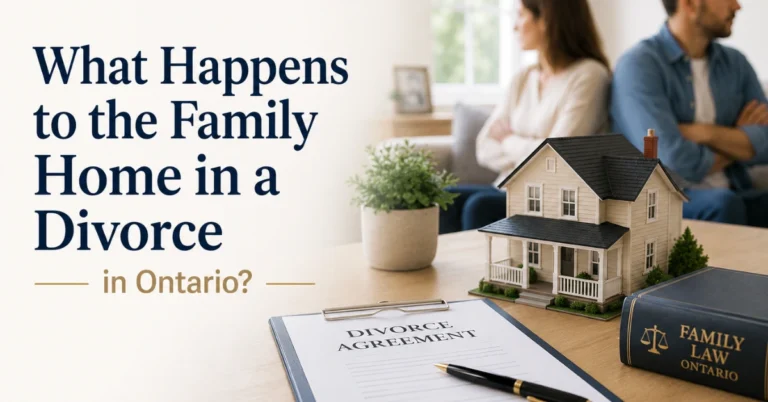
A divorce is a court order that ends a marriage. Everything else that people commonly bundle into "divorce", dividing property, arranging parenting time, setting support, is separate legal work that may run alongside the divorce or before it. Neither spouse's agreement is required merely for the other to apply; one spouse can start the proceeding on their own, though the case can grow more complex if the other side disputes what is being asked for.
The path from separation to a signed order is not one line of dominoes. It branches. Working through the branch points in order is the fastest way to see which application path applies to your situation and which procedural steps you will actually take.
If you have been served with divorce papers, the more useful starting point is Nussbaum Law's guide to what to do after being served. The page below is written for the person deciding how to file.
Who can file for divorce in Ontario
Under section 3 of the Divorce Act, an Ontario court has divorce jurisdiction only if either spouse has been habitually resident in the province for at least one year immediately before the proceeding begins. That is the jurisdictional rule. It is not the same as the one-year separation ground discussed below; the two rules are separate and each must be satisfied on its own terms.
If neither spouse meets that residency test, an Ontario court cannot grant the divorce. A couple who were married in Canada and now live abroad may have a narrow route to end their marriage under the Civil Marriage Act, but only where both conditions apply: the marriage was performed in Canada, and the country where either of you now lives will not recognize a Canadian marriage for the purpose of dissolving it. Ontario residency under section 3 is otherwise the condition that has to be met before anything else in this article applies.
Legal grounds for ending the marriage
Canada uses one legal ground, marriage breakdown, and section 8 of the Divorce Act sets out three ways to establish it:
- One year of separation immediately before the divorce is determined.
- Adultery by the spouse the divorce is sought against.
- Physical or mental cruelty by that spouse that makes continued cohabitation intolerable.
Most Ontario divorces proceed on separation. It requires no accusation, no evidence of misconduct, and no dispute about who did what. Adultery and cruelty are ways of establishing breakdown; they are not shortcuts that skip the process or produce an instant order. The court still tests evidence, and the same procedural steps, service rules, and child-support duty apply to any divorce. If either applies to your situation, read Nussbaum Law's page on grounds for divorce and speak with a lawyer before choosing which ground to plead.
Two features of the separation ground catch people off guard.
- You may file an application relying on one-year separation before the full year has elapsed, so long as you were living separate and apart at the start of the proceeding; but the divorce cannot be granted until the required period is complete.
- Short reconciliation attempts do not restart the clock. Cohabitation for reconciliation, where the total is 90 days or less and the primary purpose is reconciliation, is treated as continuous separation.
Choosing between a simple, joint, or general application
Under Ontario's family court procedures, divorce cases move through one of three applications, and the exact path depends on the claims being made and the specific facts; confirm with a lawyer before filing. The choice is claim-specific, not a description of how amicable the case is.
Choose the application
Simple, joint, or general
- Who files
- One spouse.
- Claims
- Divorce only. No property or support claims alongside it.
- Service
- Required after the application is issued.
- Starting form
- Form 8A.
- Who files
- Both spouses together.
- Claims
- Divorce and agreed terms written into the proposed order.
- Service
- No respondent and no service.
- Starting form
- Form 8A signed by both spouses.
- Who files
- One spouse.
- Claims
- Divorce with support, property, or parenting claims, or those claims without divorce.
- Service
- Required after the application is issued.
- Starting form
- Form 8, with supporting disclosure as required.
"Simple" and "joint" describe the paperwork route, not how amicable the case is. "Contested" is not interchangeable with "general". A case becomes contested when the other spouse disputes what is being asked for, whatever application form was used. If your case is likely to be disputed, Nussbaum Law's contested divorce guide covers what changes once an Answer is filed.
Children, property, and support that travel alongside a divorce
A divorce order ends the marriage. It does not automatically resolve property division, spousal support, child support, or parenting arrangements. Those are separate legal questions, and the available claims and correct court path depend on your circumstances. Two points deserve attention before you choose an application form, because the answer can push a simple filing into a general one.
- Section 11 of the Divorce Act requires the court to satisfy itself that reasonable arrangements have been made for the support of any children of the marriage, and it can stay the divorce until those arrangements are made. A divorce-only filing does not erase child-support obligations.
- Ontario's public guidance on dividing property states that a claim for equalization of net family property generally has a limitation period of six years from separation or two years from the final divorce, whichever comes first. Because that is a high-consequence deadline, verify your position with counsel well before either date is close.
The current Divorce Act uses parenting arrangements, parenting time, and decision-making responsibility in place of the older terms "custody" and "access". Older terms may still appear in orders and reference materials that predate the change, but new applications and orders use the current language. Where a separation agreement is the right instrument to record parenting or support arrangements before or alongside a divorce, see Nussbaum Law's page on Ontario separation agreements.
Filing your application and paying the court fees
Ontario permits online filing for simple and joint divorce and for many other family-court steps. Under the current guidance, Toronto matters file through the Ontario Courts Public Portal and matters outside Toronto file through Family Submissions Online. Portal routing and requirements change often, so confirm the current portal for your courthouse before you upload.
Fees are the same online and in person. Current Superior Court and Family Court fees include:
Court fees
The ordinary simple or joint total
Fees are paid at different stages rather than as one payment.
$25 optional: certificate of divorce.
Fee waivers may apply to most court fees, but not the $10 Central Registry fee.
What happens after the application is filed
A court clerk issues the application by signing it, dating it, applying the court seal, and assigning a court file number. The court then notifies the federal Central Registry of Divorce Proceedings and waits for a Clearance Certificate confirming no other Canadian divorce proceeding has been started between the same spouses. The current simple-divorce checklist notes this step can take four to six weeks. That is one administrative piece of the wait, not a prediction of how long the whole case will take; for scenario-specific timing, see Nussbaum Law's page on how long a divorce takes in Ontario.
At issuance, the clerk will in most circumstances also provide Mandatory Information Program (MIP) notices for the applicant and the respondent, with each spouse scheduled into a separate session. If you receive an MIP notice with your issued documents, treat it as a live step rather than paperwork to file away.
If you filed a simple or general application, service comes next
The issued application, the Continuing Record, the respondent's MIP notice if one was provided, and blank response forms must be served on the other spouse. Under the Family Law Rules, a divorce application requires special service, and the applicant is not permitted to serve their own initiating documents. Someone else who is at least 18 years old, or a professional process server, must do it; if service outside Canada is required, Hague Convention rules can apply. Proof is given by filing Form 6B, the Affidavit of Service. The current simple-divorce checklist directs applicants to serve as soon as possible and no later than six months after the application is issued; because that checklist is dated January 2023, confirm current rules with counsel before you commit to a date.
The respondent's answer window is generally 30 calendar days after service in Canada or the United States, and 60 calendar days after service elsewhere. Other deadlines can apply depending on the claims. Form 10 is the Answer. Financial and parenting-related supporting forms may accompany it depending on the claims involved.
If you filed a joint application, there is no respondent and no service. Both spouses are already asking the court for the same orders.
See the route
From application to effective divorce
The ordinary path shares common stages, but service changes depending on the application.
-
1
File the application
The application and Central Registry fees are paid at the starting stage.
-
2
The court issues the application
The clerk assigns the court file number and the Central Registry clearance process begins.
-
3
The path splits at service
Simple or generalSpecial service and proof of service are required. The Answer period follows.JointThere is no respondent and no service. -
4
Submit the finalization package
A simple-application filer still needs the final documents and hearing-list fee before judicial review.
-
5
The judge reviews and signs the order
A contested Answer or unresolved related claim can move the case onto a different path.
-
6
The divorce ordinarily takes effect 31 days later
The optional certificate of divorce is separate proof of the effective date.
Finalizing a simple divorce so a judge signs the order
Once the answer window has passed without a response, and the Clearance Certificate has been returned, a simple-application filer is not done. A finalization package still has to be filed for a judge to review the file and sign the order. It typically includes:
- Form 36 Affidavit for Divorce, sworn before a commissioner.
- Form 36A Certificate of Clerk, which the clerk completes.
- Form 25A, the draft Divorce Order the judge will sign, with copies for the court file and for mailing.
- Postage-paid, self-addressed envelopes so the signed order can be mailed to each spouse.
The $445 hearing-list fee is generally paid at this stage. Because forms and requirements change, verify the current finalization checklist with the court or counsel before you assemble the package.
When the divorce actually takes effect
Under section 12 of the Divorce Act, in the ordinary case a divorce takes effect on the 31st day after the judgment is rendered. The Act contains exceptions for special circumstances and for appeals. A certificate of divorce is optional proof of the effective divorce date and can be requested from the court. It is not the same document as the divorce order, and you will typically need the certificate, not the order, to remarry.
What the divorce order leaves unresolved
The divorce order does one thing: it legally ends the marriage. Property division works separately under Ontario's equalization regime, with the limitation clock noted above. Spousal support, child support, and parenting arrangements are separate claims that must be resolved in a separation agreement or asked for in the application itself, whether general or joint. A separation agreement is not a substitute for a divorce order, and a divorce order is not a substitute for a separation agreement; many people need both, in the right sequence.
Frequently asked questions
Do I need my spouse's agreement to apply for a divorce?
No. Either spouse may apply for a divorce alone, and the other spouse's consent is not a requirement of the application. If the other spouse disputes the divorce or any related claim, the case can grow into a contested matter, but the applicant does not need permission to start.
How long does an Ontario divorce take?
There is no single official figure. Timing depends on the application path, whether the file is complete, service, disputed claims, court schedules, and other case-specific factors. Nussbaum Law's page on how long a divorce takes in Ontario walks the drivers in more detail.
Is a separation agreement the same as a divorce?
No. A separation agreement is a private contract that can resolve property, support, and parenting issues between spouses. Only a divorce order legally ends a marriage. Many people need both.
Can I get divorced in Ontario if I was married abroad?
Yes, provided an Ontario court has jurisdiction under section 3 of the Divorce Act: either spouse must have been habitually resident in Ontario for at least one year immediately before the proceeding begins. The place of marriage on its own does not decide jurisdiction.
What if we still have unresolved children, support, or property issues?
Those are separate legal questions that can be raised in a general application or resolved through a separation agreement before or alongside the divorce. Because section 11 of the Divorce Act requires reasonable child-support arrangements and because the equalization limitation clock can start running from separation, these are the situations where individual legal advice matters most.