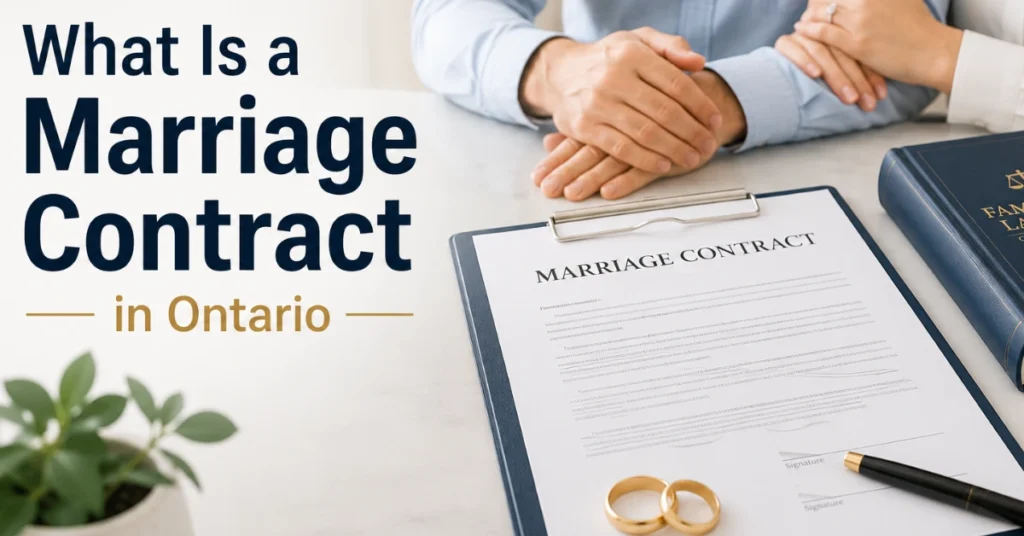


Most people call it a prenup. Ontario law calls it a marriage contract, and getting it right is what protects the house, the savings, and the business you bring into a marriage.
The short version
A marriage contract is Ontario’s real name for a prenup, and it’s set out in section 52 of the Family Law Act. You can sign one before the wedding or years into the marriage. It can settle property, debt, and spousal support, but it can’t touch child support or parenting. And it only holds up when it’s written, signed, witnessed, and backed by honest financial disclosure from both sides.
Same document. Two names.
There’s no legal difference between “prenup” and “marriage contract” in Ontario.
What is a marriage contract in Ontario?
So what is it, exactly? A marriage contract is a written agreement between two people who are married or about to be. Instead of letting Ontario’s default rules decide who gets what if you separate, you write your own rules and sign them.
Section 52 of the Ontario Family Law Act gives you that freedom. Couples use it to settle how property gets divided, who carries which debts, and whether anyone pays spousal support down the road. It matters most when one person walks in with a lot more than the other, say a paid-off condo, a family inheritance, or a stake in a company they’d rather keep out of the marital pot.
Same document as a prenup, different name. That’s really the whole trick.
Does the name matter? A little: it changes what you search for and what you ask a lawyer for. Ask a family law office for a prenup, and you’ll walk out with a marriage contract. That little “pre” also fools people into thinking the wedding is a hard deadline. It isn’t.
One caveat: if you’re living together with no plans to marry, this isn’t your document. You’d want a cohabitation agreement instead, which does the same job for common-law couples.
What you can and can’t include in a marriage contract
A marriage contract gives you a lot of room, but not unlimited room. Some terms are rock solid; others a judge will ignore no matter how happily you both signed.
You CAN include:
- How property gets divided if you separate
- Whether spousal support is paid, and how much, for how long
- Who’s responsible for which debts
- How a business, inheritance, or pre-marriage home is treated
- What happens to everything if one of you dies
You CANNOT include:
- Signing away a spouse’s right to the matrimonial home (section 52(2))
- Decision-making responsibility or parenting time for your kids
- Child support: it belongs to the child
- Any term a judge finds unconscionable
- Terms signed without honest financial disclosure
💡The matrimonial home is the one that surprises people most. Under section 52(2), you can’t sign away your spouse’s right to stay in it: a judge will strike that clause even if you both agreed to it with a smile.
Already married? You can still sign one
Because “prenup” has that “pre” baked in, plenty of couples assume the ship has sailed once they’re married. It hasn’t. A marriage contract signed after the wedding is called a postnuptial agreement, or postnup, and Ontario runs it through the very same section 52, with the very same rules.
We see couples come in for one when life shifts: the side hustle became a real company, an inheritance landed, or one partner left a career to raise the kids and wants that recognized on paper.
If the relationship is ending rather than starting, you don’t want a marriage contract at all. You want a separation agreement.
What makes a marriage contract legally valid in Ontario?
A marriage contract is only as good as its ability to survive a challenge. Sign one a judge later throws out, and all you’ve really bought is expensive paper. Section 55 of the Family Law Act sets the floor: here’s what a solid agreement needs.
- In writing: a verbal deal counts for nothing here
- Signed by both of you
- Signed in front of a witness (section 55)
- Backed by full financial disclosure from each side
- Understood by both, ideally with independent legal advice for each of you
Independent legal advice isn’t strictly required, but skipping it is a real gamble. When each person has had their own lawyer, it’s far harder for anyone to claim later they were confused or pressured. Even then, a court can set a contract aside under section 56(4) if someone hid assets, didn’t understand what they signed, or agreed to terms so lopsided they cross into unconscionable.
Disclosure is where most of these agreements live or die. It’s also where a lawyer who reads a balance sheet as comfortably as a statute earns their fee. Barry Nussbaum brings both a JD and an MBA to these files, which helps when the marriage involves a private company, an investment portfolio, or property in two countries, and the numbers have to be right the first time.
How much does a marriage contract cost in Ontario?
The honest answer is that it depends, and mostly on you. Two things move the price: how tangled your finances are, and how much you and your partner already agree before anyone starts drafting.
A tidy agreement between two people on the same page is quick work. A contested one with a business and property in three places is a different animal. And because each of you should have your own lawyer, that factors in too. Rather than trust some figure you found online, the reliable way to know is to walk through your actual situation with a lawyer, which is exactly what a free consultation is for.
Common questions about marriage contracts in Ontario
Is a marriage contract the same as a prenup in Ontario?
Yes, identical. “Prenup” is the casual, movie-borrowed word, and “marriage contract” is the term Ontario’s Family Law Act and its courts actually use. Ask for one, and you get the other.
Can you write your own marriage contract in Ontario?
You’re allowed to, but it’s a gamble. The do-it-yourself versions we see usually miss the disclosure or witnessing rules that make an agreement enforceable, which hands a judge an easy reason to void the whole thing later on. A lawyer drafting it, with each partner getting independent advice, is what makes it stick.
Does a marriage contract decide child custody or child support?
No, and trying to will backfire. Parenting time and decision-making responsibility get sorted on the child’s best interests when the issue is live, not in advance. Child support belongs to the child, so parents can’t sign it away, and a court will ignore any clause that tries.
Can a marriage contract be set aside in Ontario?
It can. Section 56(4) of the Family Law Act lets a court cancel one if a spouse hid money, didn’t understand what they were signing, or agreed to terms that are flat-out unconscionable. Full disclosure and independent legal advice on both sides are your best insurance against that.
Talk to a Toronto family lawyer before you sign
Whether you’re protecting what you’re bringing into a marriage or finally putting things in writing after years together, it’s worth getting right the first time. Book a free 30-minute review with our Toronto family lawyers: clear answers, no pressure.
Book My Free 30-Minute Review | Call 416-916-0886
Answered 24/7 · Same-day callbacks · Offices across the GTA · 7 languages